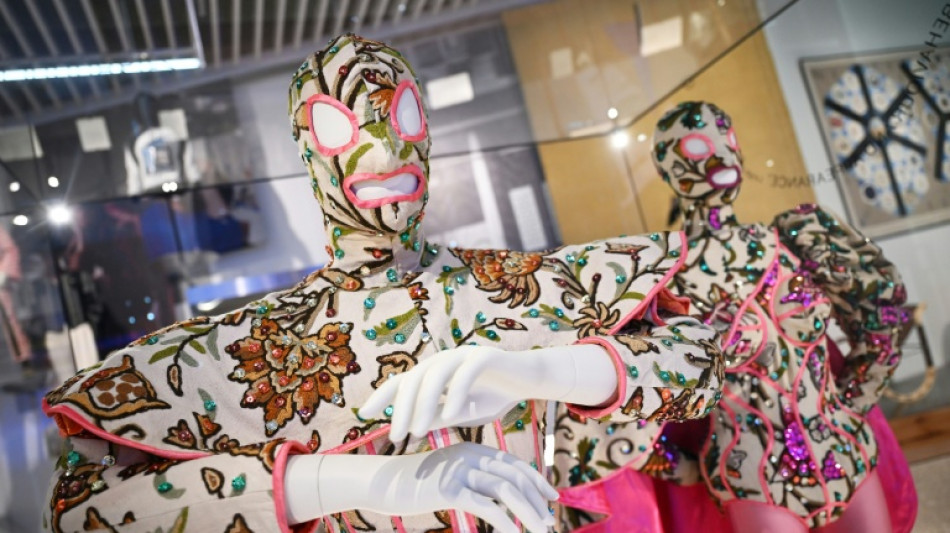
New London museum woos younger visitors / Photo: © AFP

A new London museum conceived with and for under-30s is seeking to draw younger generations by tackling themes such as climate and gender.
A honey‑coloured concrete jumble of a building now rises on the site of the former 2012 Olympic Park, in the east of the British capital.
The V&A East, which opened on April 18, is the newest outpost of the beloved 174-year-old Victoria and Albert Museum, and aims specifically at younger audiences.
Just a few metres (yards) away stands the Storehouse, open for almost a year, which allows the public to get close up with the museum's vast reserves. Yet the two V&A offshoots could hardly be more different.
The Storehouse aims to be as exhaustive as possible, brimming with objects of every kind.
The V&A East meanwhile opts for restraint -- just 500 objects are on show, displayed in an airy, light‑filled space with large picture windows.
In its two free permanent galleries are shoes by punk fashion icon Vivienne Westwood and a dress by 18th‑century English designer Anna Maria Garthwaite -- one of the first women designers.
They feature alongside contemporary works by artists from east London and beyond, including pioneering fabrics inspired by designer Althea McNish's African-Caribbean heritage.
- 'Woke' museum? -
"When we started thinking about the idea of making a museum focused on young adults, we did a lot of consultation with them for years," Brendan Cormier, chief curator, told AFP.
"We talked about the design of the galleries... and then we talked about the collections," he said.
The museum, in the making since 2012, decided to focus its exhibitions on the worldview of younger visitors, revolving around themes such as health, identity and community.
According to UK culture ministry figures from July, only 31 to 37 percent of people aged 16 to 24 visited a museum in the 12 months to March 2025, compared to 41 percent of adults.
The opening of the space comes as the role of museums in exploring social issues undergoes new kinds of scrutiny, notably in the United States.
US President Donald Trump's administration announced in August it would review certain exhibitions in Washington museums, accusing them of "wokeness" and "ideological indoctrination".
In London, more than 30,000 young people were involved in the concept -- some through their schools, others by directly visiting the museum.
A visit to the museum is like "following a thread", said Cormier.
"An object catches your eye, you go and learn more about it, and you uncover a new story, a whole new world."
- 'Dive into the unknown' -
"It's quite unnerving," murmured Londoner Amy Richard, 27, visiting with her father, a retired railway worker.
"You don't come here to see specific things, but rather to wander through a space and let yourself be surprised. I like that."
Her father, Mark, was examining a pair of Nike trainers in the sustainability section, which traces the changes in materials used in fashion.
"You mustn't be afraid to dive into the unknown," he joked.
Will that be enough to lure more young adults to museums?
US museologist and researcher Kevin Coffee sees the project as "a first step".
For him, the low attendance of young people has less to do with a lack of interest and is "more about an offer that often fails to meet their expectations and cultural practices".
A temporary exhibition, "The Music is Black: A British Story", runs until January 2027.
Visitors receive connected headphones, and the soundtrack shifts as they wander through the space, turning it into more of an immersive concert.
The exhibition traces more than 120 years of black music in Britain, from jazz and reggae to hip hop and rock, brought to the country down the years of immigration.
The exhibition "is a story of excellence, struggle, resilience and joy", the museum says.
It also addresses Britain's colonial past -- a sensitive topic for UK museums, which owe a large part of their rich collections to that complicated heritage.
Visitors are welcomed by a large map showing the spread of the UK's colonisation and the routes of the slave trade from the 16th to 19th centuries.
X.Quintero--LGdM