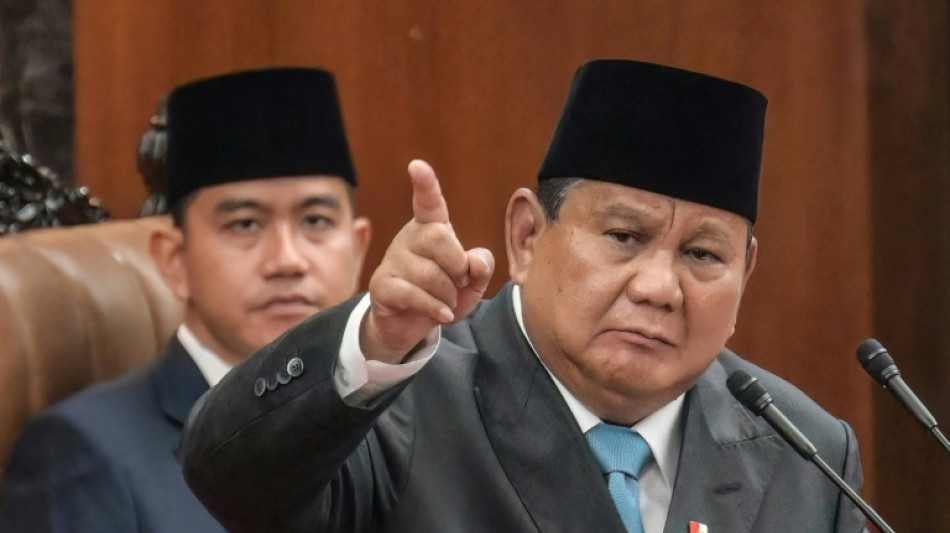
Indonesia's Prabowo announces export controls for coal, palm oil / Photo: © AFP

Indonesian President Prabowo Subianto on Wednesday announced commodity export controls to boost tax revenues as the country battles economic headwinds fuelled by the Middle East war.
Future sales of all natural resources -- starting with crude palm oil, coal and iron-containing alloys -- will go through state-owned enterprises appointed by the government, he told parliament.
"This means that the proceeds from every export sale will be passed on by the state-owned enterprises appointed by the government to the business operators managing those activities," Prabowo said.
Indonesia is among the world's top exporters of palm oil, coal and alloys, but Prabowo says the state has been losing out on revenues due to graft.
The country's Palm Oil Farmers' Organisations Association (POPSI) criticised the regulation, which it said could "fundamentally alter the structure of national palm oil trade and open wide space for trade monopolies".
The Jakarta Stock Exchange was down nearly 1.5 percent shortly before noon on the news that came on the same day Indonesia's central bank hiked its base borrowing rate by 0.5 points to 5.25 percent.
It was the first increase in two years, intended to stabilise the devaluing rupiah and keep inflation in check, said Bank Indonesia, pointing to "heightened global volatility caused by the war in the Middle East".
Prabowo said the export regulation will optimise tax revenues for the state as he presented an upbeat report about Indonesia's economic health despite "geopolitical challenges".
"The main objective of this policy is to strengthen supervision and monitoring and to eradicate underpayment practices, under-invoicing, transfer pricing practices, and capital flight of export earnings," he said.
- 'What belongs to us' -
On a day commemorating the start of Indonesia's long fight for independence, Prabowo insisted the Southeast Asian country of 287 million people was on track to achieve economic growth of 5.8 to 6.5 percent next year.
The government is targeting growth of 8.0 percent by 2029.
He also maintained the government will exceed the fiscal deficit-to-GDP ratio ceiling of 3.0 percent, set in law.
The government will work to keep 10-year bond yields in the range of 6.5 to 7.3 percent and the rupiah exchange rate to the US dollar to between 16,800 and 17,500.
"Our fiscal and monetary strategy must be a strategy capable of keeping our exchange rate stable against global currencies," said the president.
The rate on Tuesday exceeded 17,700 -- a record.
Finance Minister Purbaya Yudhi Sadewa said Tuesday the government spent about 1.3 trillion rupiah (about $73 million) on rupiah-denominated bonds in a bid to stabilise the yield.
Prabowo said the Middle East and Ukraine wars were having a "very large impact and influence" on Indonesia, which is an oil producer but net importer.
Bank Indonesia governor Perry Wajiyo pointed to global turbulence triggering capital outflows from emerging markets and a stronger dollar putting pressure on exchange rates.
Furthermore, "domestic foreign exchange demand in the second quarter of 2026", he said.
According to Prabowo, the new export regulation was an attempt to better manage "what belongs to us."
"We must believe that all of Indonesia’s natural resources belong to the Indonesian people," the president said.
"Therefore, the state has the right to know in detail which of our natural resources are being sold outside Indonesia. We do not want to be deceived any longer. We want to know exactly how much of our wealth is being sold."
Investment Minister Rosan Roeslani insisted export contracts will be honoured, "but fundamentally we will review whether the pricing in these contracts is actually correct and in line with the relevant index".
Singapore-based analyst Dedi Dinarto of the FGS Global consultancy told AFP the announcement appears to have left investors "uneasy".
"The sell-off in commodity-linked stocks shows that investors are already pricing in concerns around margin pressure, reduced trading flexibility, and policy unpredictability down the line," he said.
G.Montoya--LGdM