Trump to seek tangible trade wins in Xi summit / Photo: © AFP

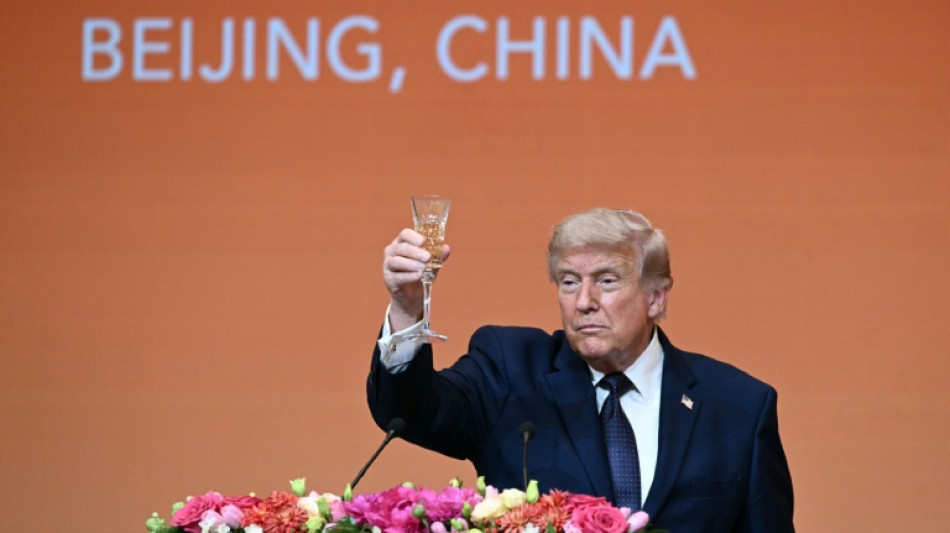
US President Donald Trump will seek out trade wins as he heads into final meetings with Xi Jinping on Friday at a superpower summit overshadowed by the Chinese leader's uncharacteristically sharp warning on Taiwan.
The US leader is hoping to seal business deals in a raft of sectors including agriculture, aviation and artificial intelligence, but will also be looking for geopolitical wins in areas including the Middle East war.
But Trump's overtures to Xi, whom he described as a "great leader" and "friend", have so far been met with more muted tones by the Chinese leader.
The warm handshakes and pomp a day earlier was overshadowed by a blunt warning from Xi that missteps on the sensitive issue of Taiwan could push their two countries into "conflict".
Trump did not comment on Taiwan to reporters on Thursday, but US Treasury Secretary Scott Bessent told CNBC the president would say more "in the coming days".
The 79-year-old Trump did discuss another critical subject however, the war against Iran, telling Fox News in an interview that Xi effectively assured his counterpart that China was not preparing to militarily aid Tehran.
"He said he's not going to give military equipment... he said that strongly", Trump told Fox after the leaders met, adding that Xi would "like to see the Hormuz Strait open" for maritime transport of oil and other critical products.
A somber Trump on Friday is expected to turn the tide of discussions towards trade, accompanied by a host of business leaders including Tesla's Elon Musk and Nvidia's Jensen Huang -- symbols of the deals the US leader is hoping to seal.
Trump, in his Fox appearance, appeared to announce one of the big business deals by saying China had agreed to purchase "200 big" Boeing jets.
Shares of the US aviation giant fell after Trump's comments, in a sign the market had expected a more robust purchase from China.
Trump and Xi were discussing setting up "guardrails" for the use of artificial intelligence, Bessent told CNBC.
Bessent said the world's "two AI superpowers are going to start talking", though US export controls on the advanced technology to China remain a sore point in relations.
The two sides are embroiled in a number of outstanding disputes and areas of contention, not least the US-Israeli war in the Middle East, which has seen Tehran close the vital Strait of Hormuz, hitting Chinese and global oil supplies.
In its brief readout, the White House said the leaders had "agreed that the Strait of Hormuz must remain open to support the free flow of energy", an issue which analysts have said could weaken Trump's position, having already forced him to postpone this trip, originally planned for late March.
- New paradigm? -
His visit to Beijing is the first by an American president in nearly a decade, and he was greeted with fanfare as he arrived for the start of talks.
Seemingly enjoying the ceremony, Trump said "the relationship between China and the USA is going to be better than ever before" and called Xi a "friend".
In contrast, Xi referenced a political theory about the risks of war when a rising power rivals a ruling one, inspired by an ancient Greek historian.
"Can China and the United States transcend the so-called 'Thucydides Trap' and forge a new paradigm for major-power relations?" Xi asked.
At a state banquet in the evening, the Chinese leader insisted it was possible.
"Achieving the great rejuvenation of the Chinese nation and making America great again can totally go hand in hand... and advance the wellbeing of the whole world," Xi said, in reference to Trump's MAGA movement.
M.Gutierrez--LGdM