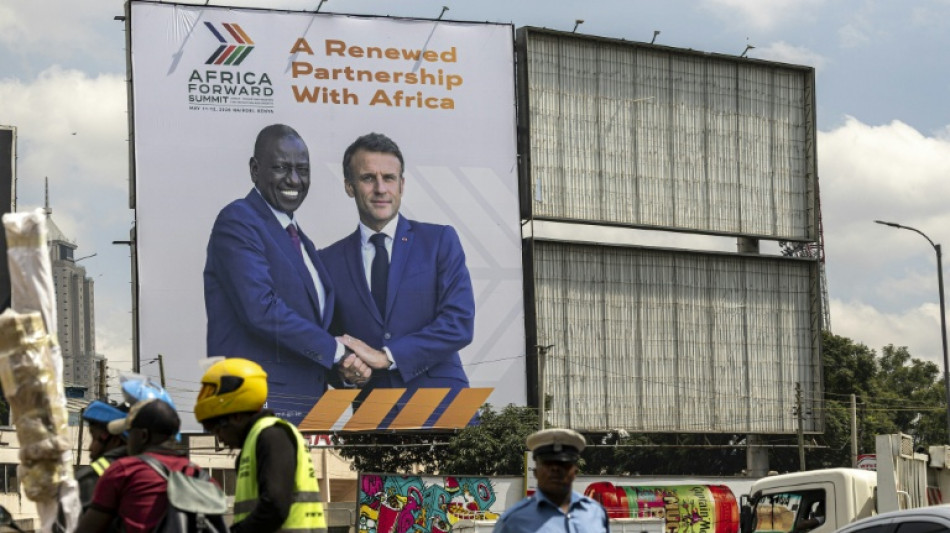
Macron seeks to cement Africa legacy with Kenya summit / Photo: © AFP

President Emmanuel Macron on Saturday embarks on a visit to Africa aimed at renewing France's engagement with the continent after years of strained ties with former French‑speaking colonies.
In English‑speaking Kenya, Macron will co‑host a summit on Monday and Tuesday bringing together African leaders and business executives, as he seeks to cement his legacy one year before the end of his term.
He will also travel to Egypt and Ethiopia as part of his Africa tour.
"The Africa Forward summit marks a major milestone in relations between France and the African continent," the Elysee Palace said.
The meeting will focus on economic development and cross‑border investment, among other themes, the French presidency said, stressing that it will be the first such forum held in an English‑speaking country.
Macron hopes to highlight France's renewed relationship with the continent as a "report card on his Africa policy", said one diplomat.
Anti‑French sentiment runs high in some former African colonies as the continent becomes a renewed diplomatic battleground, with Russian and Chinese influence growing.
Once master of vast expanses of northern, central and western Africa, France has played a crucial role in the continent's post‑colonial history, repeatedly intervening militarily since the early 1960s.
France has vowed to abandon the so‑called "Francafrique" strategy, under which Paris sought to keep francophone Africa under its thumb through political collusion, exclusive access for French businesses and oblique financial deals including graft.
- 'Anglophone Africa' -
Macron has gone further than his predecessors in admitting France's colonial-era abuses in countries including Rwanda, Cameroon and Senegal. But he has ruled out any official apology for torture and other abuses carried out by French troops in Algeria.
Ahead of his trip, French parliament definitively adopted legislation to simplify the return of artworks looted during the colonial era.
But under his watch, French forces deployed in Mali, Burkina Faso and Niger withdrew following successive coups, as the juntas in those countries drew closer to Russia.
The unravelling of those ties came after Macron in 2020 summoned leaders of Mali, Niger, Burkina Faso, Chad and Mauritania to the southwestern French town of Pau, threatening to pull out French troops.
The meeting was widely seen as a throwback to the colonial era and accelerated France's crisis in ties with the countries in the Sahel.
Amaka Anku, head of the Africa section at Eurasia Group, a risk analysis firm, said Macron should not be blamed for France's loss of influence in the Sahel.
"That was a long time coming, it's inherited," she told AFP.
"The best thing Macron did was to try to expand France's relations with anglophone Africa."
The military leaders of Mali, Burkina Faso and Niger will not attend the summit.
- 'Too much baggage' -
Africa expert Niagale Bagayoko expressed scepticism about what Macron might be able to achieve.
"Nothing particularly new can happen in Franco‑African relations before the end of Emmanuel Macron's term," she said.
"There is too much baggage."
She said Macron was perceived by many in Africa as a leader who had "failed to grasp" the evolution of public opinion and was seen as "arrogant and paternalistic".
Some still remember how Macron in 2017 nearly sparked a diplomatic incident with Burkina Faso's then‑president Roch Marc Christian Kabore as he spoke to students in Ouagadougou.
Some complained of persistent electricity cuts, and when Kabore briefly left the room, Macron joked that he had gone to fix the air conditioning.
Critics also pointed out that the overhaul of the CFA franc, a France-backed currency used by some African countries and seen as a relic of the colonial past, did not amount to much.
Former French ambassador Nicolas Normand said the reform was "homeopathic", accusing Macron of failing to grasp the symbolic weight of a colonial‑era legacy.
Before travelling to Kenya, Macron will unveil the new campus of a university in Alexandria in northern Egypt alongside President Abdel Fattah al-Sisi.
On Wednesday, the French president will travel to Addis Ababa where he will hold talks with Mahmoud Ali Youssouf, chairperson of the African Union Commission, and UN Secretary General Antonio Guterres.
Y.Suarez--LGdM