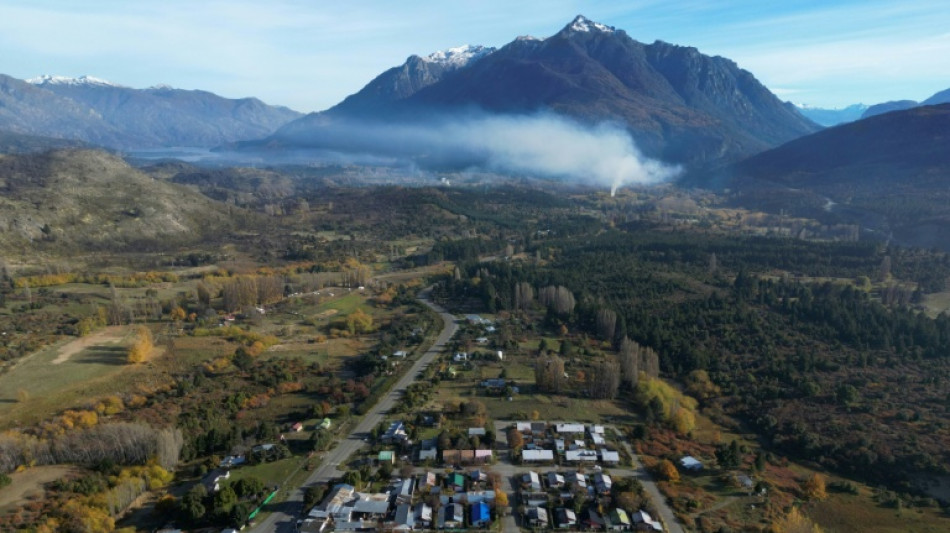
Hantavirus outbreak renews painful memories for Patagonian village / Photo: © AFP

Mailen Valle lost her father and two sisters during a hantavirus outbreak more than seven years ago in Epuyen, a village in Argentina's Patagonia region.
With the recent hantavirus outbreak on the MV Hondius cruise ship, hard memories have resurfaced for the 33-year-old.
"Losing my dad and my two sisters in less than a month..." she told AFP, trailing off.
Her voice broke and she laughed nervously, opting to read from a prepared statement because she knew it would be hard to speak.
"Nobody was prepared to see how, in a matter of days, a family table was left empty," she said.
While the Hondius outbreak has left three people dead, it has yet to surpass the Epuyen outbreak, which recorded 34 cases and 11 fatalities between December 2018 and March 2019 in the town of 2,400 residents, situated in a part of the Andes where hantavirus is endemic.
Mailen's father, Aldo Valle, came down with it after attending a birthday party.
"The person with the virus was just sitting at the same table as my dad. And at that table there were several people who got infected, and people died," Mailen recalled.
The wake for Valle was another locus of infection, where all three of his daughters got sick.
One sister died "within hours" of showing symptoms, while for the other, "we had to take her to the cemetery without a wake," Mailen said.
- Pre-Covid isolation -
The variant of the hantavirus suspected in both outbreaks is transmitted through the droppings, saliva and urine of the Andean mouse.
Jorge Diaz, an epidemiologist with Chubut province's health department who worked on the Epuyen hantavirus outbreak, told AFP that "we knew very little about the disease" in 2018.
Human-to-human transmission of hantavirus was first discovered in 1996 in the neighboring town of El Bolson, and it was later found to have happened in Epuyen.
"We implemented quarantine, which required those who made contact with a positive case to isolate for 45 days," Diaz explained.
About 100 people ended up undergoing the quarantine process in a display that would foreshadow the Covid-19 pandemic that broke out a year later.
The approach, dubbed "selective isolation," marked a shift in the epidemiological response, and now "each time there is a case of (Andes) hantavirus, isolation is ordered or recommended."
- 'One thing after another' -
Residents in Patagonia know how to protect themselves from the virus, which they refer to as "the hanta," by airing out sheds and cleaning areas with bleach.
But the human transmission of the Epuyen outbreak changed the scale of the fight, as one could get infected from their neighbor just as easily as from an Andean mouse.
Mailen remembers the stigma. "We felt very discriminated against," she said.
Others recall being banned from shops in nearby towns.
Isabel Diaz, 53, survived the outbreak with a different stigma -- her father, Victor Diaz, was labeled "patient zero," and attended the birthday party while displaying the early symptoms of hantavirus.
"People looked poorly at my father. It's not his fault he got sick," she told AFP, her eyes welling up.
"Nobody chooses to get sick, much less infect others, much less lose a mother."
Isabel got sick from her father's hantavirus case, as well as her mother. "She was the sixth patient" of the eleven who died, she said.
Her father, for his part, recalled how it felt to come down with hantavirus, causing body aches and a bitter taste that even made sipping water unpleasant.
"It started with a feeling of weakness. I didn't feel like eating. And I started to get purple spots," he said. "That same day, I lost consciousness."
In the years since the hantavirus outbreak, Epuyen has endured the Covid-19 pandemic and major wildfires in 2025 and 2026, permanently changing the landscape.
"It's one thing after another," Victor said, laughing.
"No one is going to tell us what it means to live life and keep moving forward," Isabel Diaz added.
S.Ramos--LGdM