Mitsui Chemicals to Acquire JSR in Record $11.6 Billion Semiconductor Deal

Mitsui Chemicals Inc. has agreed to acquire JSR Corp. in a deal valued at 1.84 trillion yen ($11.64 billion), marking the largest merger and acquisition in Japan’s chemical industry history. The move is designed to significantly expand Mitsui’s portfolio of semiconductor materials, positioning the company to capitalize on the rapid growth driven by artificial intelligence applications.
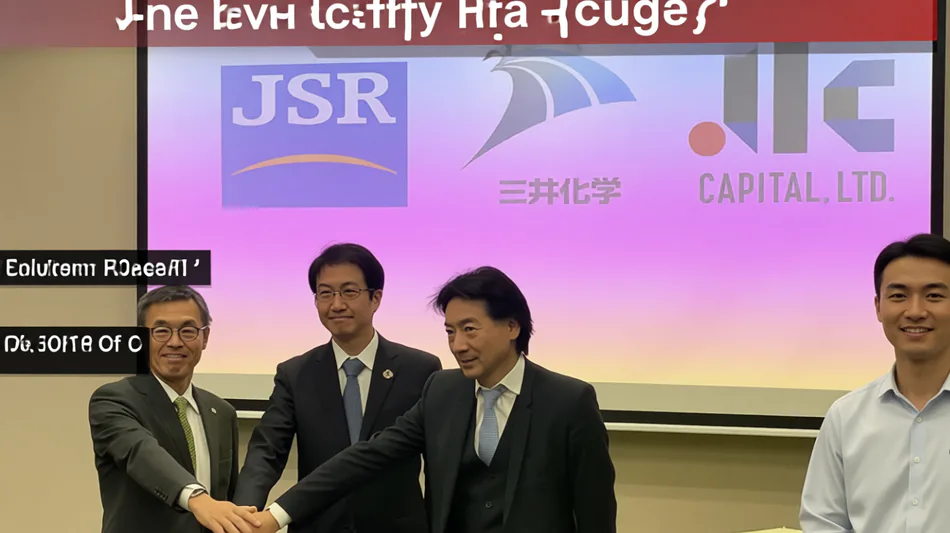
Mitsui Chemicals Inc. announced on November 9 that it will acquire JSR Corp., the world’s second-largest supplier of photoresists, in a transaction effectively valued at 1.84 trillion yen ($11.64 billion). The deal represents the largest merger and acquisition in the history of Japan’s chemical industry and signals a strategic pivot by Mitsui to become a dominant player in high-performance materials for the semiconductor sector.
The acquisition involves purchasing JSR from Japan Investment Corp. (JIC), a government-backed fund that took the company private in 2024. JIC had previously restructured JSR, divesting non-core businesses to concentrate its resources on semiconductor materials, a field projected for strong growth. Mitsui Chemicals aims to complete the acquisition and formally integrate JSR as a subsidiary during the second half of fiscal 2027.
President Satoshi Ichimura emphasized that the transaction goes beyond simple business expansion. "We are not merely reinforcing our semiconductor materials business," Ichimura told a news conference. "We will accelerate our group’s transformation toward our goal of becoming a ‘global specialty company’ in high-performance materials."
Mitsui Chemicals is currently the global leader in pellicles, protective membrane materials essential for semiconductor lithography processes. However, the company has faced challenges in broadening its product lineup, with only three semiconductor materials generating annual sales exceeding 10 billion yen. By bringing JSR under its umbrella, Mitsui intends to offer customers a comprehensive range of materials across both front-end and back-end chipmaking processes.
The financial structure of the deal is substantial. Of the total acquisition cost, share purchases will account for 1.3921 trillion yen. Additionally, Mitsui Chemicals will assume 447.9 billion yen of JSR’s interest-bearing debt and other liabilities. The total value of the acquisition exceeds ten times the company’s previous largest deal, a $900 million purchase of U.S. dental materials maker Ultradent Products Inc. completed earlier this year. It also represents approximately three times Mitsui Chemicals’ market capitalization, which stands at just above 600 billion yen.
To finance the transaction, the Development Bank of Japan (DBJ) will contribute 200 billion yen toward the acquisition price. The DBJ plans to convert its purchased shares into nonvoting preferred stock. Mitsui Chemicals intends to cover the remaining portion through bridge loans, with a plan to restore its financial health within three years via public stock offerings and asset streamlining.
The timing of the acquisition aligns with surging demand for semiconductors, largely driven by the widespread adoption of generative artificial intelligence. Ichimura stated that AI has become part of the fundamental infrastructure underpinning daily life, and the company is proceeding on the assumption that the market will continue to grow despite recent concerns.
Concerns regarding the outlook for investments in AI semiconductors and data centers have emerged recently. These worries are partly attributed to the Democratic Party winning control of both houses of Congress in the U.S. midterm elections, where support for AI regulation is a key platform point. Furthermore, the semiconductor industry is known for requiring continuous, large-scale capital investment and being subject to significant market fluctuations.
Despite these risks, the acquisition supports national policy objectives. In June 2023, Japan’s industry ministry set a target in its semiconductor and digital strategy to triple domestic sales of semiconductor-related products to 15 trillion yen by 2030. JIC acquired JSR for about 1 trillion yen to bolster the nation’s chip supply chain and sought a buyer that could strengthen international competitiveness and facilitate industry consolidation.
Shogo Ikeuchi, president of JIC Capital Ltd., noted that the fund selected Mitsui Chemicals from among seven or eight competing acquisition proposals. He emphasized that particular importance was placed on whether the buyer could serve as a platform provider for semiconductor materials capable of supporting the domestic industry.
Mitsui Chemicals projects that leveraging synergies with JSR, such as cost reductions, will add 40 billion yen to its annual profit by fiscal 2035. The company acknowledges the risks inherent in the semiconductor market but views the acquisition as a critical step in capturing the growth of the fast-expanding sector.
The deal follows a period of significant consolidation and strategic realignment in Japan’s technology sector. JIC’s intervention in JSR’s management reflects broader efforts to secure the nation’s position in the global chip supply chain. As Mitsui Chemicals moves forward, it faces the challenge of integrating a major competitor while navigating the volatile nature of semiconductor investments and the evolving regulatory landscape surrounding artificial intelligence.
P.Ortega--LGdM