'Dancing in their hands': Japan wig masters set stage alive / Photo: © AFP

Every actor in kabuki -- a traditional Japanese performing art celebrated for its striking makeup and elaborate costumes -- relies on one final, essential element to fully inhabit their role: the wig.
Ahead of a show at the famed Kabuki-za theatre in central Tokyo, wig master Tadashi Kamoji carefully places a topknot creation on a young performer in a flamboyant kimono costume.
"A kabuki actor can't just walk onto the stage as he is... it's only when he puts on a wig that he truly becomes a kabuki performer," 60-year-old Kamoji told AFP.
"So we must take pride in our job with a sense of very heavy responsibility."
Often hidden behind the curtain, the profession has found itself in the international spotlight after "Kokuho" -- a box-office hit about two "onnagata", male players of female kabuki roles -- was nominated for Best Makeup and Hairstyling at the Oscars this year.
Dating back to the 17th century, Kabuki is a fusion of dance, drama and music, and sees actors don ornate costumes, wigs and heavy makeup for performances in old dialect on elaborate sets.
After a craftsman creates the wigs using human hair, Kamoji's job is to style them.
But his role goes beyond that of hairdresser.
"You cannot do a good job if you don't grasp the character's nature," said Kamoji, a fourth-generation "tokoyama" who joined the profession at 18.
Whether it's a middle-aged man with a strong sense of justice, or a high-ranking courtesan, a wig serves to convey age, social status, occupation and personality.
At his atelier, Kamoji spent two hours fashioning the wig for the young actor, sculpting beautifully curved sides and a topknot called a "mage" -- a classic hairstyle modern Japanese no longer wear -- for his sumo wrestler role.
Kneeling on a tatami floor, he sectioned the hair using a traditional comb and smoothed it with steaming irons, occasionally pulling a string with his teeth to secure strands.
These specialists are "truly indispensable," the wig's 33-year-old recipient Nakamura Tanenosuke, told AFP.
"There is almost no kabuki performance without wigs," said the actor, who has been working with the masters since the age of five and is sporting Kamoji's artistry this month for his show about a noble family feud.
- 'The final touch' -
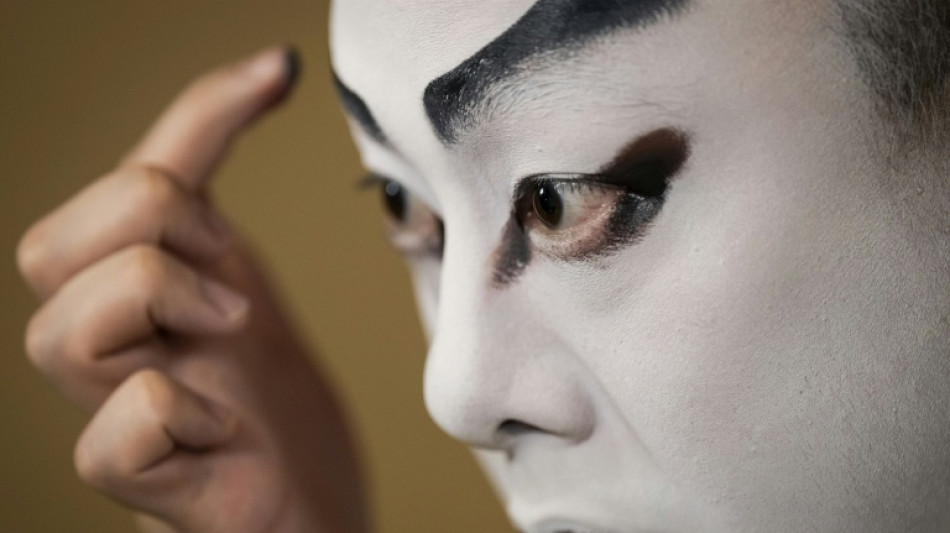
Backstage at the Kabuki-za theatre, Tanenosuke covers his face in thick white foundation and his assistants help him pull on a large, navy-and-white striped kimono.
"The wig is the final touch that completes the transformation. I see each step as a switch leading to that exact moment when you fully become the character," Tanenosuke said.
"As well as the artistry of the actors, the beauty of the costumes and stage sets is also key to the audience's enjoyment, and I believe the wigs play a part too."
In total, there are around 400 types of wigs for female roles, and 1,000 for male parts.
A fresh creation is crafted for each performance and customised for each actor, taking between a few hours and a month to complete depending on the complexity.
Despite doing the job for four decades, Kamoji says he's only just come to believe he's capable.
"To this day, there are still things I learn from my father" who is 85, he said.
"It's endless. When I watch the seniors, it looks as though the hair is dancing in their hands.
"I don't think I'm there yet, but I suppose I will be able to control hair when I'm about my father's age."
But the efforts feel worthwhile when actors receive a huge cheer or a round of applause on stage.
"I feel as though part of it belongs to us," Kamoji said.
"If the audience thinks the actor looks brilliant, it makes me feel that our (wig) perhaps suited him. I very much feel a sense of joy in that."
Y.A. Ibarra--LGdM