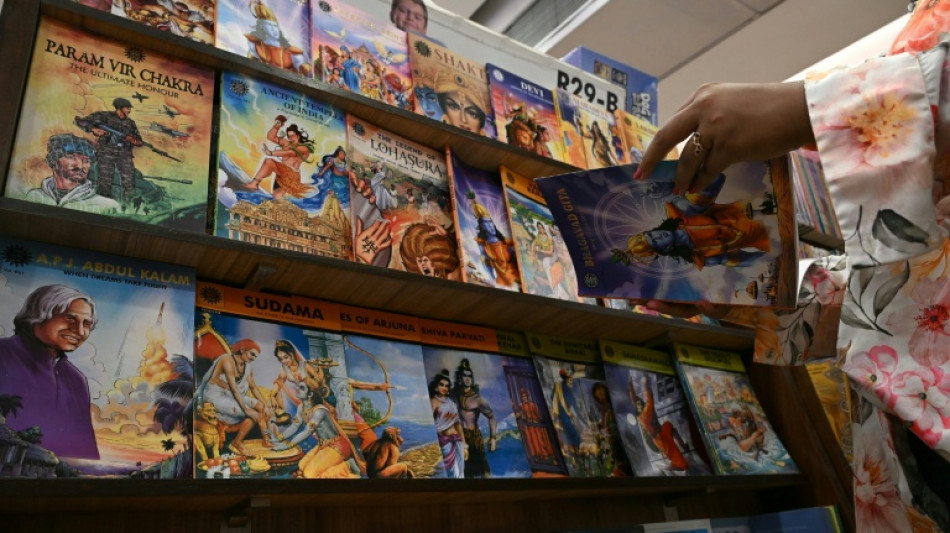
'Immortal' Indian comics keep up with changing times / Photo: © AFP

When India's comic book series Amar Chitra Katha was launched in 1967, its mission was simple: introduce children to the country's vast universe of Hindu gods, legends and history.
Nearly six decades later, the comic, known simply as ACK and meaning "immortal illustrated stories", is still holding its ground in an era ruled by smartphones and streaming television.
Founded by storyteller Anant Pai after he noticed children on a quiz show knew more about Greek gods than their own mythological heroes, ACK quickly became a cultural touchstone.
Its titles, from tales of Hindu deities to biographies of freedom fighters, sold in the millions and were translated into multiple regional languages.
The journey has faced turbulence.
The arrival of the Cartoon Network in India and a blockbuster television adaptation of the Hindu epic "Mahabharata" dented sales.
Last year, a fire at their Mumbai warehouse destroyed part of the company's precious archive.
Still, the publisher marches on -- powered not just by nostalgic adults, but by their children too.
"The largest number of readers for Amar Chitra Katha are between 25 and 45," executive editor Reena I. Puri told AFP.
"They are the ones who've been brought up with Amar Chitra Katha... and give it to their children to read."
ACK fan Aarav Vedhanayagam said his favourite was about an air force pilot who won India's highest military medal.
"I love how they narrate the stories, and also the drawings," the 13-year-old said.
"From the smallest child to the oldest grandfather -- it is suitable for all ages."
- 'Really develop' -
Production depends on the same painstaking research, writing and colouring, although some images of deities have evolved.
"We used to have a very slender Ram, a very slender Shiva, drawn lovingly by artists who drew by hand," said Puri, 68, who has been with ACK for 34 years.
"Today the artists... give them six-pack abs and muscles."
Not all fans love the makeover, but Puri said times change.
"Children today are not used to that old kind of art," Puri said. "We have to adapt to what the children want."
Storytelling has also shifted.
"If, earlier, we used to show the man sitting with a newspaper, and the woman sweeping the floor or cooking food, that's changed," she added.
"It could be the woman sitting and reading a book, and the man gets her a cup of tea."
The Covid-19 pandemic forced ACK to confront the digital age head-on, making its app free for a month, sparking a surge in readers.
More than a quarter stayed on, and today, digital earns nearly as much as print.
"We realised that here was something that we could really develop," said Puri.
- 'Art is to be respected' -
But one frontier is firmly off‑limits: artificial intelligence.
"Art is to be respected, a writer's work is to be respected", Puri said.
Comic designer Srinath Malolan, 24, who grew up reading ACK in his school library, said the human-made process ensures content remains safe for children.
"The internet can create whatever it wants... we have meticulously looked at what we are giving the kids," Malolan said.
Puri is confident in ACK's future.
"The focus for us is our founder's vision... to tell the stories of India to the children of India," she said. "It's always going to be relevant."
M.Lozano--LGdM