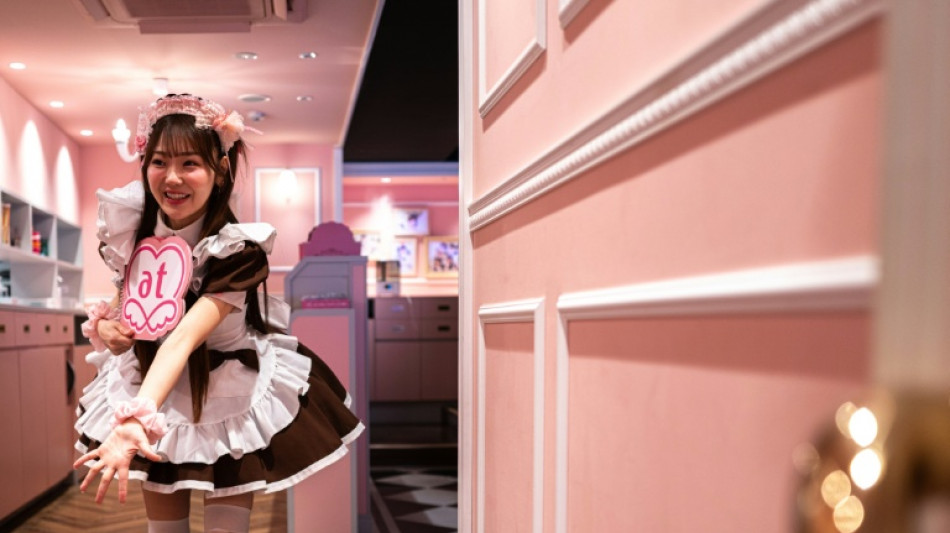
'Geek' hangout to tourist draw: Japan's maid cafes / Photo: © AFP

"Master, mistress -- welcome home!" exclaims the smiling young woman in a French maid's costume, as customers pass through the looking glass into a unique Japanese world with oodles of quirkiness, cuteness and cake.
These "maid cafes" -- inspired by the traditional maid outfit that has long been a motif in Japanese pop culture -- have evolved from niche subculture hangouts 20 years ago into a mainstream attraction for people of all ages and genders.
And staff working there insist that the experience is not in any way designed to titillate, saying it is meant to be a wholly innocent family-friendly experience.
"I've been fighting against prejudice for 22 years," Hitomi, a "maid" in Tokyo's Akihabara neighbourhood where the cafes started, told AFP.
"Little remarks can be hurtful... In those moments, I tell myself that what we do isn't yet sufficiently understood."
Waitresses, wearing a short dress, petticoat, pinafore and hair accessory, serve brightly coloured drinks or twee delights like a dish called "Wan Wan! Puppy Curry Rice" (made with beef) or "Cutie Toy Poodle Cake".
But the experience is more about the interaction with customers, with the maids clasping their hands together in heart shapes, chanting "magic spells" over the food, singing songs or playing games.
"We serve food and drinks, but to me, it is more like a theme park than a cafe," said Hitomi.
In this fairytale world, "the waitresses aren't just 'girls,' but rather slightly fantastical characters who are eternally 17 years old", the mother-of-two told AFP, preferring not to give her real age.
At-Home Cafe, which employs 650 maids across 13 locations, says it has strict rules to protect staff and govern interactions with patrons. This includes no touching and prohibiting the maids from handing out flyers on the street.
French tourist Taha Hsine, 26, visiting a cafe with his girlfriend, admitted that he had half-expected to see "sweaty guys coming in to see their favourite maid".
He told AFP at first it was "difficult to be at ease. In France, we're not used to this kind of thing".
"But otherwise, the experience itself, even the way the meals are prepared, I find it really stylish."
"I was expecting a mostly male audience, but there are a lot of foreigners and women," agreed Japanese customer Hazuki, 19, visiting with her boyfriend "out of curiosity".
Others queueing to enter were an excited seven-year-old girl from South Korea on her third visit with her mother and grandmother.
- Otaku -
The trend emerged in the early 2000s in Akihabara, renowned at the time as the birthplace of "otaku", sometimes translated as "geek", culture.
This term, then largely pejorative, usually described men with an intense passion for manga and anime.
"When I first became a maid, Akihabara was very much an 'otaku' district where a girl like me wasn't exactly welcome," Hitomi recalled.
"Over 90 percent of the customers were men, they wouldn't make eye contact with me, and they struggled to carry on a conversation."
But the meteoric rise of all-girl pop group AKB48 -- short for Akihabara -- and TV series "Densha Otoko" ("Train Man"), a romantic comedy about a young "otaku", helped soften the scene's edges.
"A genuine 'Akihabara boom' then took place," explains Ryo Hirose, a subculture specialist at the NLI Research Institute.
"Completely ordinary people began flocking there, and 'otaku' -- along with their culture and even the maids themselves -- were, in a sense, transformed into attractions."
At-Home Cafe, one of the leading chains, says that women now make up 57 percent of the customers registered on its app.
Some maids have become quasi-celebrities and media personalities, building their personal brand on social media and sometimes sought out by customers.
Many cafes have implemented a complex membership system, where frequent visits unlock privileges such as special menu items, the right to take a Polaroid photo with the maids, or discounted rates.
- Grey zone -
Researcher Hirose said that the interactions in maid cafes are sometimes built upon a "pseudo-romance" fantasised by some regular customers.
"Some may come to believe that the other person actually has feelings for them," he said.
Over time other kinds of "concept" cafes have also emerged, featuring everything from ninjas to cross-dressing women and liveried butlers.
There are venues operating in "a kind of grey zone, with at times very borderline commercial practices. Under the guise of concept cafes, some in reality offer services that include sexual activities," Hirose said.
"You can ask questions regarding stuff like hobbies, what they like (and) dislike," said Michal Ondra, a 35-year-old Czech tourist who says he has spent nearly 500 hours at maid cafes.
"But you cannot ask things like 'Where do you live?' or 'Do you have a boyfriend?'. Personal questions have to be very shallow," Ondra told AFP.
R.Andazola--LGdM