Thailand's 'Jurassic Park' shines light on dinosaur evolution / Photo: © AFP

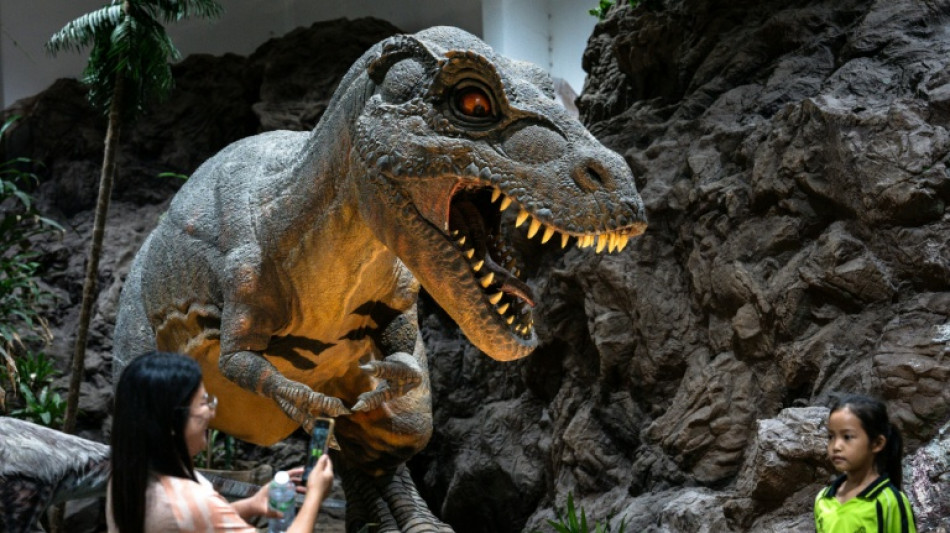
A dinosaur statue stands guard outside a temple, a hint at the ancient giants buried deep in the earth below making up northeastern Thailand's "dinosaur rush".
Researchers have found a trove of dinosaur fossils across the region, which holds the country's richest deposits, offering insight into the creatures that roamed the planet millions of years ago.
Prehistoric specimens from the region's sun-baked soil were identified this year as two new species -- Southeast Asia's largest dinosaur Nagatitan chaiyaphumensis and the long-necked Uragasaurus kalasinensis.
They are the latest discoveries in a series that researchers at Mahasarakham University -- which leads the field -- hope will result in Thailand's 16th species within months.
"Thailand really is the hotspot for research and discovery" in Southeast Asia, said Richard Cloutier, a professor of palaeontology visiting from Canada's Universite du Quebec a Rimouski.
While China, Mongolia and Russia remain major fossil-hunting grounds, experts say the part of the Earth that is now Thailand offers important clues to dinosaur evolution.
"The timeframe of our discoveries fills a geological gap or missing link present in records of other countries," said Suravech Suteethorn, deputy director of the university's Palaeontological Research and Education Centre.
"Our local dinosaurs are like missing jigsaw pieces that help establish evolutionary connections, particularly around the Jurassic and Cretaceous period transition, approximately 140 million years ago."
- Next big find -
Many of the specimens confirmed this year were unearthed a decade or more ago, but needed research and verification before being identified. There are more waiting to be tested.
At the university, shelves groan with jagged pieces of spines, necks and legs that to an untrained eye resemble battered stones.
Countless more fossils remain in the ground, including at Phu Wiang National Park, two hours away, where Suravech and his veteran paleontologist father -- and boss -- Varuvudh work on a dig.
Under a makeshift roof offering protection from the monsoon rains, the pair are slowly uncovering the giant neck of a fossil they hope to confirm soon as Thailand's newest dinosaur.
Suravech was tight-lipped about the find, but said it would "wow" people.
"These new discoveries indicate the grandeur and richness of our country in the past," he told AFP.
Varuvudh was on the team that announced last month the discovery of Uragasaurus, a plant-eater up to 20 metres (65 feet) long that roamed the Earth around 150 million years ago -- the first dinosaur of its kind identified in Thailand.
The news came hot on the heels of the confirmation of 27-tonne herbivore Nagatitan -- named after a serpent from Southeast Asian folklore, a giant of Greek mythology and the province of Chaiyaphum where it was found -- which lived 100-120 million years ago.
- Dinosaurs on a budget -
Northeastern Thailand is particularly well placed for dinosaur discoveries, said Thitiwoot Sethapanichsakul, a PhD student at University College London who co-authored the Nagatitan paper in the journal Scientific Reports.
Its dry climate and sparse vegetation leave fossil-bearing rocks exposed, while its geology contains sedimentary layers of the right age to preserve dinosaur remains.
"I think the current 'dinosaur rush' in Thailand is hopefully just the beginning," he told AFP.
The largely rural region is historically among the poorest in Thailand, but the discoveries are a boon to a fledgling dinosaur tourism industry in a country better known for its beaches and food.
Visiting a dinosaur museum in Khon Kaen, retiree Songyos Toongtubtim said he was "curious to learn more" after hearing about the discoveries.
Another museum opened in 2007 in the province of Kalasin -- for which the Uragasaurus was named -- and now draws hundreds of thousands of people each year.
But funding for paleontology remains limited and the research community small, while expeditions into remote areas can be costly.
"There are many fossils hidden here that are waiting for us to uncover," Suravech said.
"We seek help from the Thai government, but it's very difficult."
A lifelong fan of the Jurassic Park movies, Suravech joked that his work lacks Hollywood's deep pockets.
"I'm waiting for the moment when there's a billionaire to support the project like in the film."
S.Moreno--LGdM