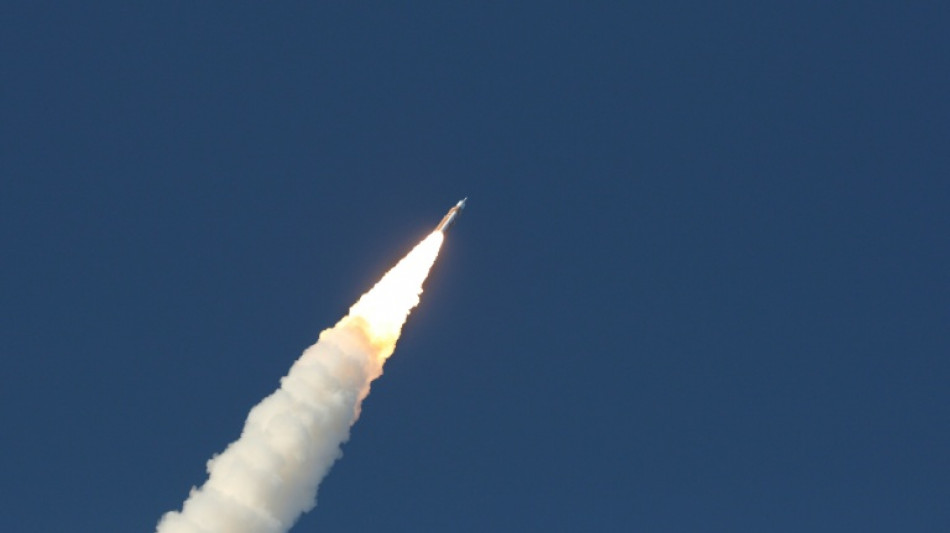
Astronauts begin NASA lunar mission after climactic blast-off / Photo: © AFP

Four astronauts blasted off aboard a massive NASA rocket Wednesday on a long-anticipated journey around the Moon, the first crewed lunar flyby in more than 50 years.
With a thunderous roar that reverberated far beyond the launchpad, the enormous orange-and-white rocket carried three Americans and one Canadian away from Florida's Kennedy Space Center at approximately 6:35 pm local time.
NASA teams and spectators alike were ecstatic as the spacecraft ascended into a radiant sky atop a cascade of flames.
"We're going to the Moon!" one onlooker exclaimed.
During final checks before Artemis 2 was deemed a go for launch, astronauts gave brief words: "We are going for all humanity," said the Canadian aboard, Jeremy Hansen.
Artemis launch director Charlie Blackwell-Thompson then addressed the astronauts directly.
"Reid, Victor, Christina and Jeremy: On this historic mission, you take with you the heart of this Artemis team, the daring spirit of the American people and our partners across the globe, and the hopes and dreams of a new generation. Good luck. God speed Artemis 2. Let's go," she said.
The team, who donned bright orange suits with blue trim as they blasted off, includes Americans Reid Wiseman, Victor Glover and Christina Koch along with Canadian Hansen.
"We have a beautiful moonrise. We're headed right at it," said Wiseman, the mission commander.
Shortly after launch they successfully entered Earth's orbit, where they will remain while performing various checks to ensure the reliability and safety of a spacecraft that has never carried humans before.
They will also test its manual piloting capabilities during docking simulations.
If all goes well they are expected to venture forth on Thursday on a loop around the Moon, which is expected to take about three days.
The voyage should last approximately 10 days in total.
"This was amazing," said Sian Proctor, an American scientist who participated in a 2021 space mission and ventured to Florida's Space Coast, where local authorities said around 400,000 people were watching.
"I'm just so happy that we're going back to the Moon, and everybody should be excited and be following the next 10 days, because this is a big step for humanity," Proctor said.
The flight is to pave the way for a Moon landing in 2028.
- Repeated setbacks -
The mission marks a series of historic accomplishments: it will send the first person of color, the first woman and the first non-American on a lunar mission.
If the plan proceeds as expected, the astronauts will set a record by venturing farther from Earth than any human before.
It is also the inaugural crewed flight of NASA's new lunar rocket, dubbed the Space Launch System (SLS).
The rocket is designed to allow the United States to repeatedly return to the Moon, with the goal of establishing a permanent base that will offer a platform for further exploration.
Wednesday marked a major milestone after years of delays and massive cost overruns for a mission that was originally due to launch as early as February.
But repeated setbacks stalled it and even necessitated rolling the rocket back to its hangar for analysis and repairs.
- 'BEYOND THE STARS' -
The Artemis program was facing pressure from President Donald Trump, who has pushed the pace of a program that aims to see boots hit the lunar surface before his second term ends in early 2029.
But the projected date of 2028 for a landing has raised eyebrows among experts, in part because Washington is relying on the private sector's technological headway.
The current era of American lunar investment has frequently been portrayed as an effort to compete with China, which is aiming to land humans on the Moon by 2030.
"We are WINNING, in Space, on Earth, and everywhere in between -- Economically, Militarily, and now, BEYOND THE STARS. Nobody comes close! America doesn't just compete, we DOMINATE, and the whole World is watching," Trump posted on Truth Social.
M.Aguilar--LGdM