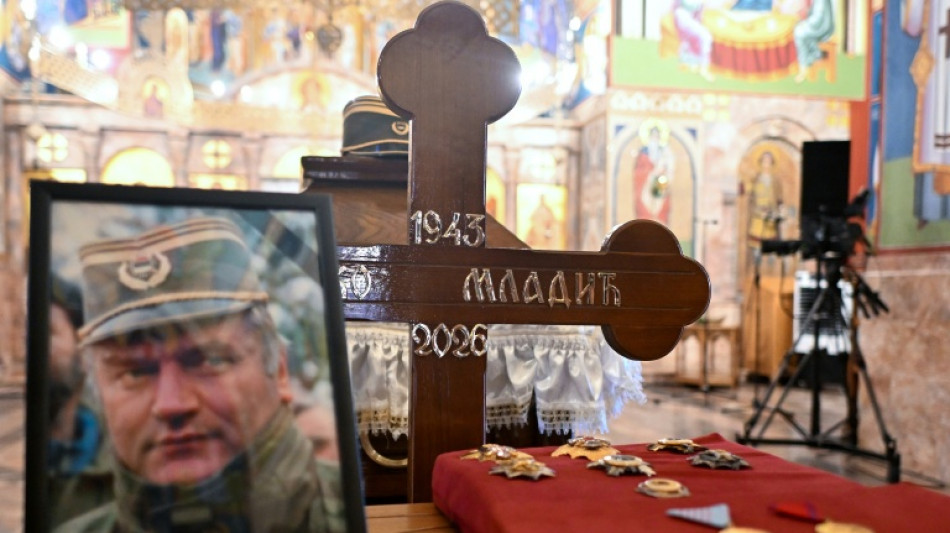
Thousands bid farewell to Bosnian Serb war criminal in Belgrade / Photo: © AFP

Bosnian Serb war criminal Ratko Mladic was buried in Belgrade on Monday, in a service attended by thousands, sparking accusations from Brussels of the "glorification" of a man who died while serving a life sentence for genocide.
Mladic died in The Hague last month, aged 84, after being convicted of genocide, war crimes and crimes against humanity committed during the 1990s Bosnian war -- a reputation that led the international press to dub him the "Butcher of Bosnia".
Serbian Justice Minister Nenad Vujic initially announced "military and state honours" for Mladic, triggering international outrage, before President Aleksandar Vucic tempered the decision.
Vucic has rejected accusations of glorifying the former general, describing the service as in keeping with the family's wishes.
Darko, Mladic's son, who officially organised the funeral, stood by the casket early on Monday as the service began, with mourners streaming into the church, many kissing the coffin.
It was held at the small St Luka church rather than the grand temple of Saint Sava, where state funerals are normally organised.
Still, several Serbian ministers attended, alongside Russia's ambassador to the country and the Bosnian Serb entity's former president Milorad Dodik.
Vucic earlier said the state would ensure the event passed off "safely", but he would not attend in person due to a prior engagement.
-'National hero'-
After hours with the coffin on display, the head of the Serbian Orthodox Church held a service inside the church.
"We know that his name will remain deeply etched in the memory and prayers of the majority of our Serbian Orthodox people, who feel and nurture a deep sense of gratitude towards him," Patriarch Porfirije said.
As the casket was carried outside by soldiers, waiting crowds lined the street, waving flags bearing the former general's face alongside large national tricolours of Serbia and the Bosnian Serb entity Republika Srpska.
According to AFP journalists and aerial footage of the procession, crowds in the area numbered in the thousands as the slow procession moved towards the nearby Topcider cemetery.
Despite his conviction, many Serb nationalists continue to paint Mladic as a hero and protector, particularly in the Republika Srpska where his death sparked vigils.
"I am here to see off the general, a national hero," pensioner Radojka Visic, who had travelled from Republika Srpska's capital Banja Luka, told AFP.
Nearby Milovan Bajic, said he was the "the greatest Serb and general". "For every true Serb, Ratko Mladic is a sacred figure," he said.
A slow procession took Mladic's coffin to Topcider cemetery, where it was buried, surrounded by mourners.
"They set up artificial courts for our heroes in order to turn defenders into criminals and traitors into heroes. Thank you, brothers, for coming to decide whether my father was a hero or a criminal," Darko Mladic said before the coffin was lowered into its grave. The crowd, many of them war veterans and young men, then responded by chanting: "Hero! Hero!"
The former general was buried next to his daughter, who killed herself during the Bosnian war.
- 'Revisionism' -
The scenes in Belgrade following Mladic's death prompted condemnation from regional and international leaders, including the European Union.
"Any glorification of war criminals, genocide denial and revisionism contradict the most fundamental European values and have no place in the EU or in EU candidate countries," an EU spokesman said in a statement on Monday.
Mladic was the military figurehead of the Bosnian Serb leadership alongside former Yugoslav president Slobodan Milosevic and Bosnian Serb leader Radovan Karadzic.
The United Nations war crimes court convicted him of genocide over the 1995 Srebrenica massacre, where Bosnian Serb forces killed around 8,000 Bosnian Muslim men and boys in a UN-protected safe zone.
The atrocity was Europe's worst act of bloodshed since World War II.
Mladic was also convicted of persecuting and forcibly expelling Bosnian Muslims and Croats, terrorising civilians during the siege of Sarajevo and taking UN peacekeepers hostage during NATO airstrikes in 1995.
He was arrested in 2011, 16 years after he was first indicted, and sentenced to life in prison in 2021 after a nine-year trial. Ahead of the funeral the Association of Mothers of Srebrenica called for international institutions to act, describing it as a "disgrace".
But on Serbia's pro-government commercial television station, Informer, the live broadcast of the memorial was glowing.
"History is being written," one commentator said on the channel, in rolling coverage with an image of Mladic's face superimposed in the corner of the broadcast.
R.Andazola--LGdM