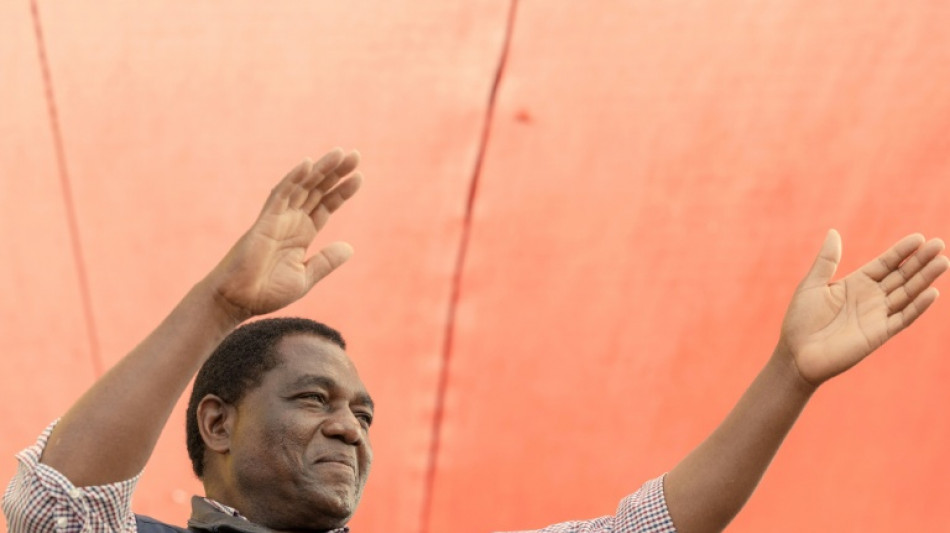
Zambia's Hichilema: 'cattle boy' and two-time president / Photo: © AFP

Hakainde Hichilema, who secured a second term as Zambia's president on Tuesday, built a business empire before first winning the presidency in 2021, but says he remains at heart an ordinary "cattle boy".
Known simply as "HH", the 64-year-old tycoon first came to power after defeating his longtime rival Edgar Lungu in a landslide win on his sixth run for the top job.
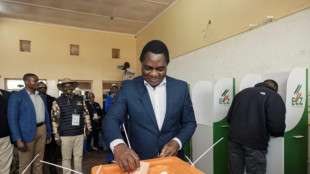
He won the August 13 poll with around 60 percent of votes against his closest rival, Brian Mundubile, who mounted a spirited last-minute challenge for the presidency in a bitter accusation-filled election.
Hichilema entered the race as the clear favourite after steering Zambia through a major economic turnaround, restructuring its debt, restoring ties with international lenders and courting millions of dollars in investment, particularly in the country's valuable copper industry.
He had also made primary and secondary education free.
But while inflation has eased, the economic gains have not been felt evenly for the more than 70 percent of the population which lives on less than $3 a day, according to World Bank data.
"We love you so much and this is why we are working round the clock to lower the cost of living," Hichilema -- often affectionately referred to as "Bally", or Dad -- told supporters ahead of the August 13 election.
His first term was marked by concerns over Zambia's political space, with opposition parties and civil society groups accusing his government of curbing dissent.
At least a dozen opposition members were arrested ahead and after the vote.
- Maximum-security prison -
Hichilema says he has been arrested 15 times since he entered politics, becoming leader in 2006 of the liberal United Party for National Development (UPND) that he had bankrolled.
After losing the 2016 election to Lungu, he was charged with treason for allegedly failing to pull over for the presidential motorcade.
He spent four months in a maximum-security prison before the charges were dropped.
The experience shaped his promise of a "better democracy", he would say later, a pledge that sits uneasily alongside the criticism of his own government.
Hichilema inherited a deeply troubled economy when he took office in 2021.
Years of heavy government spending had left Zambia heavily indebted and in 2020 the country became the first African nation to default on its debt during the Covid era.
Having overseen the economic turnaround, he has set an ambitious 2031 target to triple production of copper, of which Zambia is Africa's second-largest producer.
The southern African country also holds significant deposits of cobalt, nickel and manganese.
- 'Cattle boy' -
One of Zambia's wealthiest men, HH has spent much of his political career trying to persuade the public that he is not removed from the lives of ordinary people.
"I'm just a cattle boy. I love spending time dipping cattle, it's a childhood love," he told AFP in an interview in 2021, describing himself as "an ordinary African".
He was born into a poor family in the southern district of Monze and says his "grit and determination" won him a scholarship to the University of Zambia.
He graduated with a degree in economics and business administration before getting an MBA at Britain's University of Birmingham.
At age 26, he was already CEO of the Zambian branch of a large international accountancy firm.
Hichilema went on to build a business empire spanning finance, ranching, property, health care and tourism.
Once known for economic jargon and tailored suits, Hichilema recast his public image, often swapping the boardroom look for jeans, fatigues and his trademark half-jacket.
On the 2026 campaign trail, he embraced the youth catchphrase "Salt Sana" -- or "more salt" -- urging voters to "add more flavour" by choosing him.
A Christian from the Tonga ethnic group, Hichilema is married and has three children.
B.Ramirez--LGdM