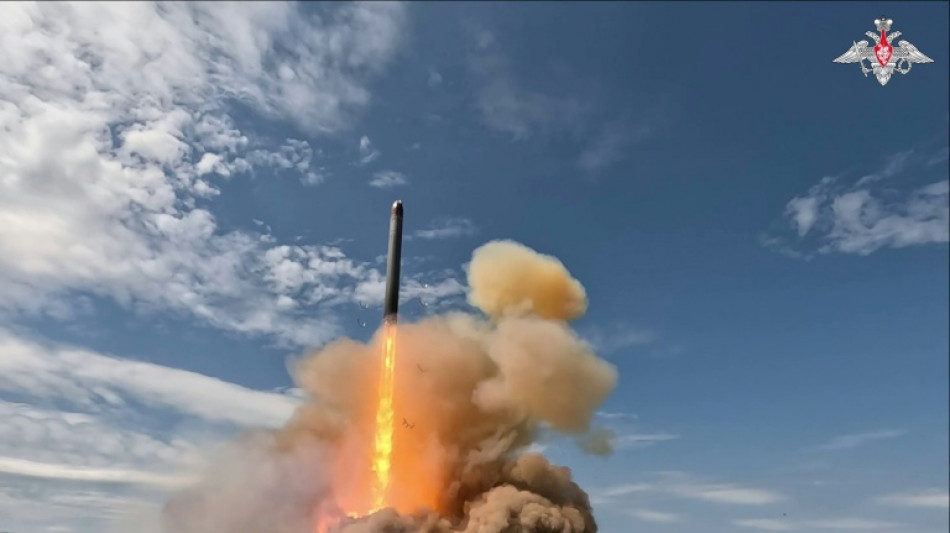
Russia tests long-range missile after US nuclear treaty expires / Photo: © Russian Defence Ministry/AFP

Russia on Tuesday tested a new long-range missile capable of carrying nuclear warheads, months after the last treaty with the United States limiting their atomic arsenals lapsed.
The ending of the New START agreement in February formally released the world's two largest nuclear powers from a raft of restrictions.
"This is the most powerful missile system in the world," claimed Russian President Vladimir Putin after receiving a report of a successful launch of Sarmat, an intercontinental ballistic missile (ICBM).
He said the missile could carry a warhead more than four times more powerful than anything Western militaries possessed, adding that Sarmat would be on "combat duty" by the end of this year.
Even though Moscow and Washington agreed to reestablish high-level military dialogue shortly after New START expired, there were no immediate signs of renewing or prolonging it.
US President Donald Trump has repeatedly pressed for a new treaty to include China, whose arsenal is growing but still significantly smaller than those of Russia or the US, but Beijing has publicly rejected the pressure.
Trump had been mostly silent on Russian calls to extend New START, which was signed in 2010 and imposed the last restrictions on Moscow and Washington after decades of agreements dating from the Cold War.
Both countries have repeatedly accused each other of failing to adhere to the agreement.
Sarmat, referred to as "Satan II" in NATO designation, is the first ICBM produced in post-Soviet Russia to be classed as "super heavy".
Put said it was capable of travelling 35,000 kilometres (22,000 miles).
A.Soto--LGdM