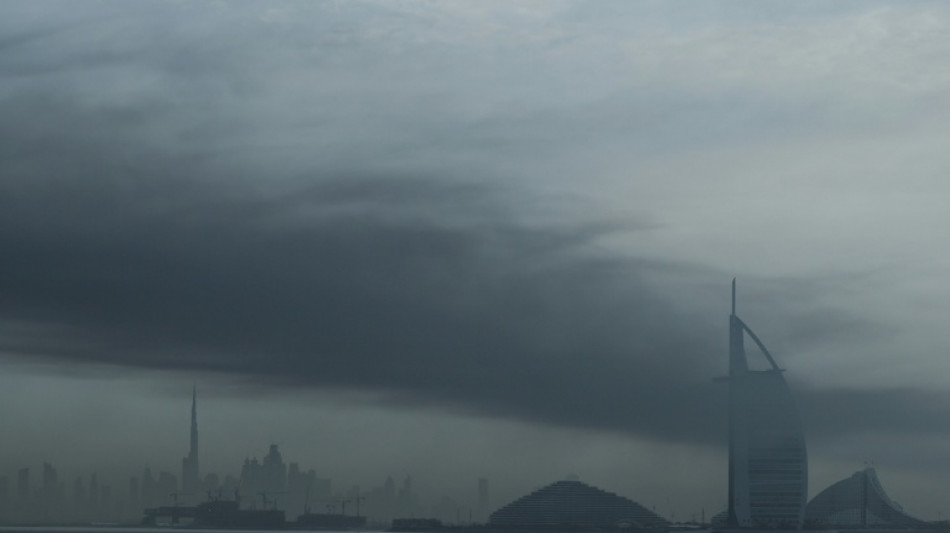
Fresh wave of Israeli strikes on Iran, Gulf nations also hit / Photo: © AFP

Fresh strikes rocked Iran and several Gulf countries Friday, as Israel and the Islamic republic unleashed a new wave of attacks in a war that has ignited the Middle East and threatens to torpedo the world economy.
Since erupting on February 28 with US-Israeli attacks on Iran, the war has cascaded throughout the region, drawn in global powers, and sparked a major oil shock.
Unusually powerful explosions rattled Tehran on Friday morning, AFP journalists reported, as Israel's military said it had hit more than 200 targets in western and central Iran in the past day.
The blasts shook the houses of two AFP journalists, located several kilometres apart in the north and centre of the Iranian capital, with black smoke pluming over the city.
Iranians speaking to AFP under cover of anonymity have painted a grim picture of life under the bombs, with cities in ruins and cash running short.
"People are desperately trying to withdraw their savings from the banks, as trust in them has vanished," one 30-year-old woman in Kermanshah, western Iran, told AFP.
"Bread is now rationed. The population is extremely tense and outraged."
The United Nations refugee agency has estimated that up to 3.2 million people have been displaced inside Iran since the Middle East war started.
Iran's health ministry said on March 8 that more than 1,200 people have been killed in the war, a figure AFP has not been able to independently verify.
Iranian state TV images broadcast crowds of pro-government demonstrators in Tehran and other major cities to mark Quds Day, the last Friday of Ramadan, supporting the Palestinian cause.
Demonstrators waved Iranian flags, held placards and banners reading "Death to America" and "Death to Israel" as well as similar slogans.
Iran's Revolutionary Guards, the ideological arm of the country's military, warned Friday that any new protests against the authorities would be met with a stronger response than in January, when several thousand people were killed.
- 'We won't leave' -
Iran has launched waves of drone and missile strikes against neighbouring states hosting US military assets throughout the region.
Saudi Arabia's defence ministry said Friday its forces had intercepted dozens of drones, including one targeting its capital's Diplomatic Quarter.
AFP images showed black smoke hanging over the iconic skyline of Dubai after an attack on what was once considered a safe haven in a chaotic region.
Two people died from drone debris in Oman, according to state media there, while sirens rang out early Friday at Turkey's Incirlik airbase, a key NATO facility housing US troops.
In a sign of the war's spread, President Emmanuel Macron announced the death of France's first soldier, in an attack in the Erbil region of Iraq.
Macron did not give details on the attack, or who was behind it, but France's military said earlier that drones hit a base where troops were taking part in counter-terrorism training with Iraqi counterparts.
Earlier, a pro-Iranian group in Iraq, Ashab al-Kahf, warned French interests in the region were a target after the arrival of a French aircraft carrier, but there was no claim of responsibility for the attack.
Elsewhere in Iraq, a US refuelling aircraft crashed, though the US military said it was "not due to hostile fire or friendly fire."
Iran's military however said in a statement carried by state TV that an allied group in Iraq had downed the aircraft with a missile, killing all its crew.
A strike on the Israeli town of Zarzir injured around 60 people, according to Israeli police, with AFP images showing burned-out vehicles and craters in the ground.
The conflict has heavily impacted Lebanon, where authorities reported 687 people killed by Israeli attacks, including at least 12 in a strike Thursday on Beirut's seafront, where displaced families are camping in tents.
Dalal al-Sayed told AFP she had pitched her tent there after fleeing attacks in southern Lebanon. Her family cannot afford to rent an apartment, she said.
"We won't leave, we will stay here even if we die."
AFP images from central Beirut showed buildings reduced to husks of rubble and burned-out shells of overturned vehicles as small fires flickered from the aftermath of strikes.
- 'Evil Empire' -
Crude oil stayed above the benchmark price of $100 per barrel after Iran's leader vowed to choke the Strait of Hormuz, a critical artery for global energy transport.
Mojtaba Khamenei, who was reportedly wounded in the strike that killed his father, has not appeared publicly since his nomination. His message calling for vengeance was read by an anchor on state television.
The statement said the "lever of blocking the Strait of Hormuz must definitely be used," referring to Iran's effective closure of the waterway.
The war, which has also seen energy infrastructure targeted in oil-rich Gulf states, is creating "the largest supply disruption in the history of the global oil market," the International Energy Agency has said.
As prices at the pump soar around the world, Trump has eased some oil sanctions on Russia, which has warned the global energy market "cannot remain stable" without its supplies.
Trump said fuel prices were secondary to "stopping an evil Empire, Iran, from having Nuclear Weapons, and destroying the Middle East and, indeed, the World."
As stock markets suffered globally, analysts warned of a prolonged period of pain.
"The default assumption -- as long as the Strait of Hormuz remains functionally closed -- is that stocks will be under pressure, oil prices will trend higher, and interest rates will tick up in unison," said Matt Weller, head of market research at City Index.
burs-ric/ser
D.Ancira--LGdM