End of an era as Bangladesh ex-PM Zia dies / Photo: © AFP

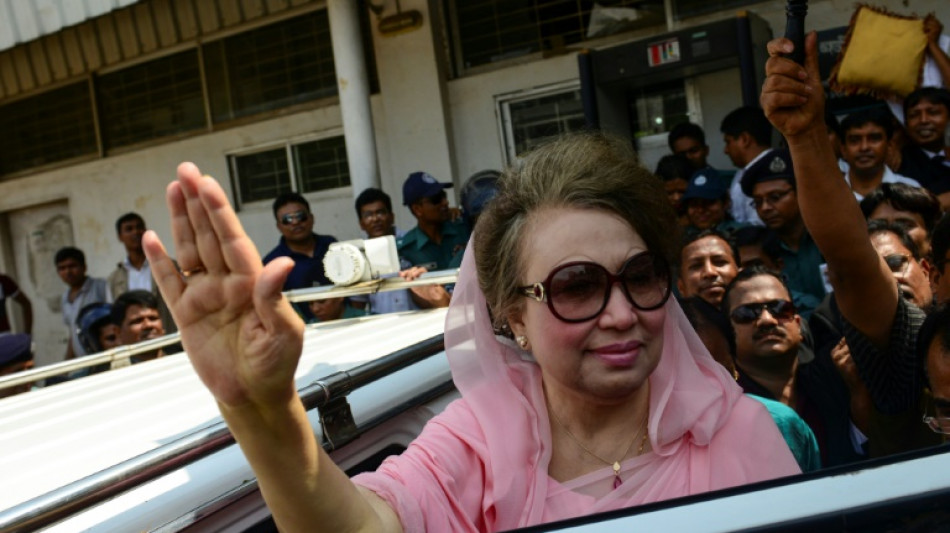
Bangladesh's three-time prime minister Khaleda Zia, who hoped to lead her nation one last time after elections next year, died on Tuesday aged 80.
Zia, a dominant figure for decades in the South Asian country's turbulent power struggles, had vowed to run in elections next year, the first since a mass uprising toppled her arch-rival.
Despite years of ill health and imprisonment, just last month Zia had promised to campaign in elections expected in February 2026, in which her Bangladesh Nationalist Party (BNP) is widely seen as a frontrunner.
"Unite the party and prepare to lead," Zia had urged BNP members earlier this year.
But in late November she was rushed to hospital, where despite the best efforts of medics, her condition declined from a raft of health issues.
Zia was jailed for corruption in 2018 under the autocratic government of Sheikh Hasina, which also barred her from travelling abroad for medical treatment.
She was released shortly after Hasina's ouster in August 2024.
- 'Battle of the Begums' -
For decades, Bangladesh's politics was defined by the bitter rivalry between Zia and Hasina -- a feud dubbed the "Battle of the Begums", an honorific title in South Asia for a powerful woman.
The hatred traces back to the 1975 assassination of Hasina's father, independence leader Sheikh Mujibur Rahman, along with most of her family, in a coup.
Three months later, Zia's husband, Ziaur Rahman, then deputy army chief, effectively took control. He became president in 1977. He was himself assassinated in 1981.
Zia, then a 35-year-old mother of two, inherited the BNP leadership.
Initially dismissed as a political novice, Zia proved a formidable opponent, rallying against military dictator Hussain Muhammad Ershad, and later joining forces with Hasina to oust him in 1990.
The two women alternated in power for the next decade and a half.
Their intractable rivalry fuelled crises, including the January 2007 standoff that brought military-backed emergency rule. Both women were detained for more than a year.
Hasina later dominated, ruling from 2008 until her violent downfall in 2024.
Zia's own tenure left a mixed legacy: she was admired for her resolve but criticised for her refusal to compromise, which often left her isolated, domestically and internationally.
But Zia's political legacy may yet continue.
Her son, Tarique Rahman, 60, long seen as her political heir, has also said he will run in the polls.
Rahman, known in Bangladesh as Tarique Zia, returned from exile in London on December 25, after fleeing what he called politically motivated persecution in 2008.
Following Hasina's fall, he was acquitted of the most serious charge against him: a life sentence handed down in absentia for a 2004 grenade attack on a Hasina rally, which he has always denied.
His image is displayed alongside his mother's on party banners, offering a potential new chapter in Bangladesh's enduring political saga.
S.Olivares--LGdM