Yemeni city buckles under surge of migrants seeking safety, work / Photo: © AFP

Once a picturesque Red Sea port, the city of Aden in government-controlled Yemen has been transformed by the massive influx of people fleeing war: electricity cuts are constant, running water scarce and the meagre public services badly overstretched.
The centuries-old city has become a haven for people seeking safety and work since Iran-backed Houthi rebels seized the capital Sanaa, forcing out the sitting government.
The displacement, which has more than doubled the city's population, has put a massive strain on water and electricity services, hitting both recent arrivals and longtime residents.
Meanwhile, the coastal city has attracted many of the thousands of African migrants who have landed on people-smuggling boats each month, hoping to reach the wealthy Gulf but instead getting stuck in the Arabian Peninsula's poorest country.
Mohammed Saeed al-Zaouri, Yemen's minister of social affairs and labour, told AFP that 755,000 registered and an untold number of unregistered people have arrived in Aden.
He put the city's current population at around 3.5 million, more than double the 1.5 million of 20 years ago.
"This number is beyond Aden's capacity," he added.
- 'Limited supply' -
The conflict between the rebels and a Saudi-led international coalition has created one of the world's worst humanitarian crises, with most of Yemen's population dependent on aid despite a truce since 2022.
The seat of Yemen's displaced government since 2014, Aden bears the unmistakable signs of conflict, with homes pockmarked by bullet holes and buildings lying in ruin.
All around, roads are gridlocked by traffic, while the southern city is scattered with generators, water trucks and military checkpoints.
In the crowded city, residents are worn out.
Under the harsh glare of floodlights, pre-charged for use during power cuts, Mohammed grows frustrated as the latest hours-long outage cuts phone and data networks.
The 37-year-old government employee admits that even before the war, the city's services were under strain.
But they have grown worse and worse, he says.
"The displaced have to share with residents the limited supply of water and have put additional pressure on electricity services and the telecommunications network," Mohammed, who only provided his first name, told AFP.
In October, the capital plunged into a complete blackout for five days -- the third such outage this year -- due to fuel shortages.
- Tent cities -
To add to Aden's woes, rents have soared.
For Mohammed, the government worker, his monthly salary of about $80 is unable to cover rent. Most apartments start at $106.
The shortfall has forced him to delay his marriage plans.
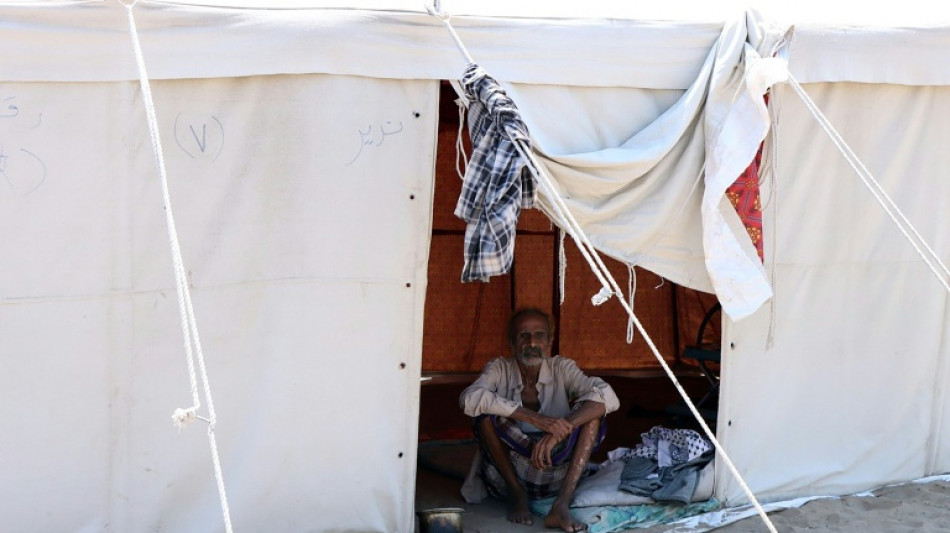
Many of the displaced have also been priced out of rented properties, pushing thousands to live in camps on the outskirts of Aden.
Among them is Abdulrahman Mohyiddin, who fled with his eight children from the coastal city of Hodeida in 2018 to escape the fighting.
There, his family live in a canvas tent, where they lack access to the most basic necessities -- water, electricity and beds.
Experts are now warning that the city's ability to absorb the expanding population is likely at an end.
Farea al-Muslimi, a Yemen expert at Chatham House in London, said the complete collapse of services in Aden was "only a matter of time".
"The city overall is drowning in sewage, constant power cuts, and worse, poor governance," he told AFP.
- 'Exhausted, just like us' -
Hundreds of thousands have died in fighting or knock-on effects such as malnutrition because of the war, which has left Yemen divided between Houthi and government areas.
Even though fighting has eased, Aden's economy has nosedived since 2024 following the depreciation of the local currency, the halt of oil exports and funding restrictions.
Parents from three different families around the city told AFP their children rely on the packets of fortified biscuits distributed by the United Nations at schools.
Around 19.5 million people -- more than half of Yemen's population -- were in need of humanitarian assistance in 2025, including 4.8 million internally displaced, according to UN figures.
Even Aden's ritzier areas are coming under strain.
At the entrance to the Coral Aden Hotel -- which hosts diplomatic missions and political meetings -- a frail police dog sits, unable even to bark.
A guard checking vehicles at the hotel admitted there was no budget to provide the dog with its own food.
"He is exhausted, just like us," he told AFP.
"He shares our poverty and our leftover food."
L.Flores--LGdM