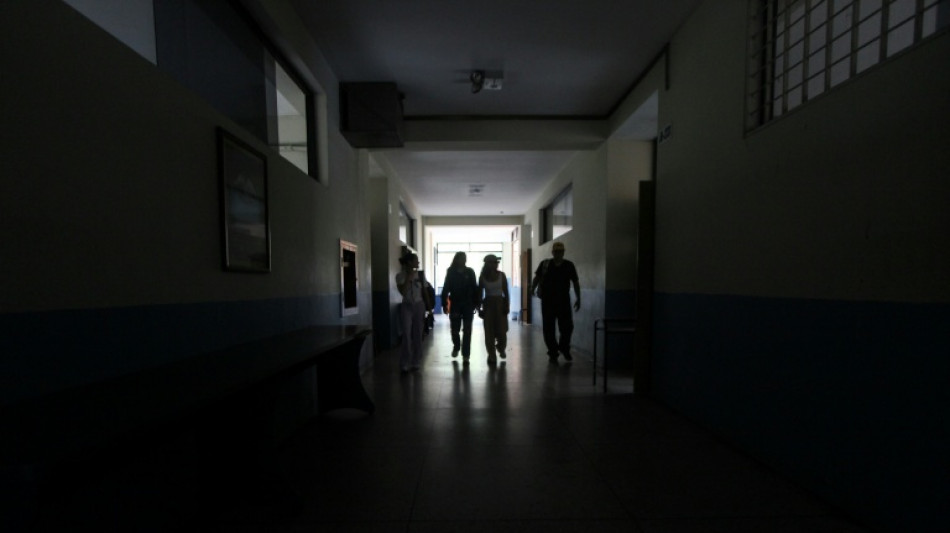
Venezuelans outside Caracas say capital not sharing blackout burden / Photo: © AFP

Josner Herrera is sick and tired of dealing with daily power cuts, especially when her part of western Venezuela produces a fair bit of electricity.
Residents of Tachira say they believe that authorities are diverting electricity from their state to the capital Caracas, where blackouts are more rare.
"I'm really fed up and exhausted. And now I see that we could have power all the time, but it seems we have to feed the bubble (in the heart of Caracas) so the people in the neighborhoods don't rise up," Herrera, a 38-year-old secretary, told AFP.
Venezuela desperately needs to boost its electricity output to kickstart its oil industry -- and keep its citizens powered up.
Officials have managed in recent years to keep the lights on in Caracas, but outside the capital, and especially in the west, power outages are frequent.
But suggestions by a local politician this week that the rest of Venezuela was bearing the brunt of the hardship to keep people in Caracas happy reignited the debate.
Former regional lawmaker Heriberto Labrador said at a public event that the thermal power plant in Tachira was generating 70 megawatts of electricity -- sufficient to cover regional demand.
But much of that power is diverted to the national grid.
"If there is a surplus, then it gets given to them, but what we need here is a government that wants the best for Tachira state," Labrador told AFP.
Some towns in the state have experienced power outages that have lasted up to 26 hours. Cuts of five hours or more have become commonplace.
Those cuts "cripple economic activity and are having grave consequences for the cold supply chain for farmers and livestock producers" seeking to deliver perishable goods, Labrador said.
And of course, regular citizens also suffer.
- 'That's enough' -
This week, exasperated residents blocked the highway linking Tachira state to Barinas at night, banging pots and pans and honking horns in protest.
"It's incredible. They are making a mockery of the people of Tachira. We've been putting up with this for years," said Irma Villasmil, a 48-year-old assistant manager at a bank in San Cristobal.
"We've always had rationing just so Caracas doesn't have to go without electricity."
Villasmil's refrigerator has broken twice due to power surges, she said.
"That's enough, we're done paying the price for the capital. What injustice!" she complained.
The ruling party governor of Tachira state, Freddy Bernal, has been in his job for nearly five years. When asked to comment on situation by local media, he dodged the question.
In recent months, the government of interim president Delcy Rodriguez has launched reforms in the oil and mining sectors aimed at attracting much-needed foreign investment. But those industries need power.
Rodriguez, who is governing under Washington's watchful eye since the January ouster of Nicolas Maduro, has submitted power industry reforms to lawmakers, but they have not yet been approved.
She has meanwhile sealed a major oil deal with the United States that grants Washington access to a huge chunk of Venezuela's crude reserves -- and includes contracts with foreign companies such as GE Vernova to restore 5,000 megawatts of power capacity over four years.
- Feeling desperate -
That could prove to be an uphill battle.
Opposition lawmaker Ezio Angelini says Venezuela produced 20,000 megawatts a day and consumed just 12,000 before longtime leader Hugo Chavez took power in 1999.
Today, average daily production is just 12,000 megawatts, while demand is at least 14,000, he says.
During a recent visit to Caracas, US Energy Secretary Chris Wright insisted on the need to revamp Venezuela's ability to generate power.
In the meantime, residents of Tachira and other Venezuelan regions are feeling desperate.
In mid-August, protests erupted in Barinas and Valencia, the country's third-largest city, as well as oil industry hub Maracaibo.
Though the government announced last month that it would shorten the work day for public sector employees to ease the electricity crisis, several parts of Caracas have begun experiencing power cuts.
Y.A. Ibarra--LGdM