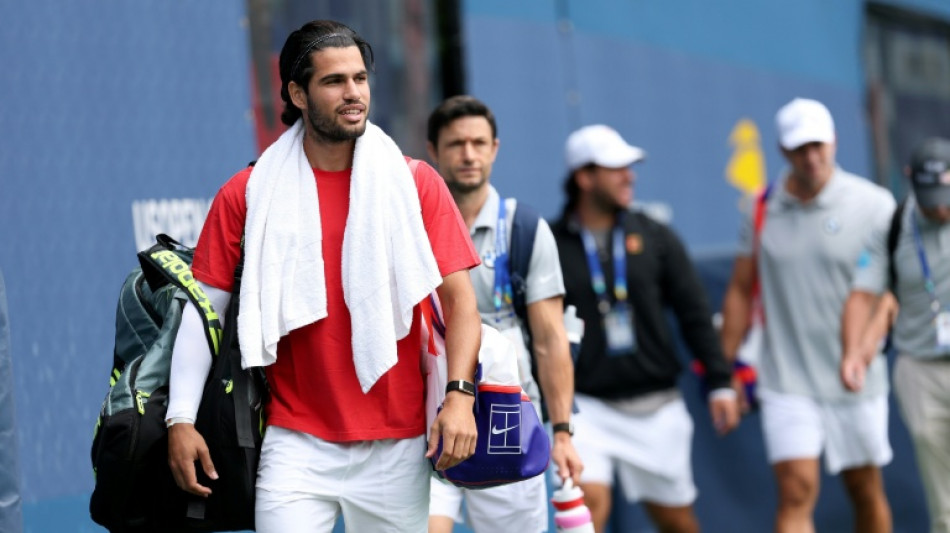
Injuries cloud tennis as US Open gets under way / Photo: © GETTY IMAGES NORTH AMERICA/AFP

After Carlos Alcaraz and Jannik Sinner split last year's Grand Slams, the two superstars were expected to continue their see-saw rivalry in 2026.
That hasn't happened.
Instead, injuries have foreclosed the possibility of a clash between the two champions in three of the four Grand Slams, with the Spaniard missing the French Open and Wimbledon due to a wrist injury and the Italian absent from New York because of a knee injury.
Alcaraz and Sinner are far from alone among top players missing big tournaments in 2026 due to injury, a trend that has been a source of growing alarm in the sport.
Italy's Lorenzo Musetti and France's Arthur Fils missed earlier Grand Slams in 2026 due to injury but are playing in New York, while women's number two seed Elena Rybakina is nursing a heel injury as she prepares for her first round. Canada's Victoria Mboko missed both Wimbldedon and the US Open due to injury, along with Britain's Jack Draper.
Compared with earlier generations, today's best tennis players have access to more sophisticated practices in fitness and nutrition, greater candor about mental health and improved technology in detecting and treating injuries.
"We're losing the battle overall despite the advances in sports medicine," said Neeru Jayanthi, who leads the tennis medicine program at Emory Healthcare in Atlanta.
- Bigger, faster, stronger -
The injury problem points to the downside of the greater physicality needed to compete at the highest levels of a sport where play is becoming faster and more powerful all the time, enabled by racquet innovations that allow for wicked topspin shots that didn't exist in earlier tennis eras.
"The game has gotten more intense because the players have gotten bigger, faster, and stronger," said Mackie Shilstone, a longtime fitness expert who worked with Serena Williams for 14 years.
The faster pace places greater strain on the body when it changes direction, while more severe weather due to climate change also takes a toll, Shilstone said.
Adding to that, the big business of tennis is played over 11 months of the year, highlighted by the four Grand Slams and a series of mandatory 1,000-level tournaments.
"You can't go 11 months straight and travel all over the world," Shilstone said. "There has to be planned recovery built in."
Extreme topspin is a factor in the rising incidence of wrist injuries seen at all levels of tennis, said New York hand and wrist surgeon Remy Rabinovich at Northwell Health, who perceives a silver lining in that players are opting to rest rather than playing through pain.
"There is a big element of preventative medicine and more strategic ways of playing in the hopes of having a longer career," Rabinovich told AFP.
At a media availability Friday, Alcaraz said he decided to rest until he was ready to come back to "hopefully have a really long career," he said.
Novak Djokovic has had injuries in recent years, but at 39, remains a contender at this year's US Open.
- Cumulative damage -
Injuries in tennis are not new. Among the group of recently-retired greats, Rafael Nadal was out of commission for significant stretches in his peak years due to injury, while hip problems largely derailed Andy Murray's career after he won Wimbledon and the Olympics in 2016.
Roger Federer, who avoided major injury for most of his career, retired in 2022 after realizing "the knee can't do it anymore," he said last week.
Since Federer retired, the tours have shifted many of the 1,000-level tournaments to two-week coed events with 96-player draws, which the "players are probably mentally and physically adjusting to," Federer said, adding that not overplaying is "easier said than done."
A 2024 study by the European Journal of Sport Science in pro matches from the 1970s through 2019 pointed to an overall increase in match retirements.
But a 2016 study showed no increase in injuries at Wimbledon between 2003 and 2012, while ruing "a paucity of published data describing the incidence of injury in elite tennis."
Mitigating injuries is expected to figure into a Grand Slam Player Advisory Council announced earlier this week, according to a press release that identified player welfare as an aspect of the council's mandate.
Addressing the tennis schedule is the most often-discussed response to the injury problem, but Emory's Jayanthi argues for a broader approach, maintaining that major injuries are often the result of cumulative wear and tear from more years of intense play in juniors.
"Perhaps we should revisit the way we decide to train our younger players to position them for long-term success," he said.
D.F. Felan--LGdM