Vaccine gaps fuel Bangladesh's deadly measles crisis / Photo: © AFP

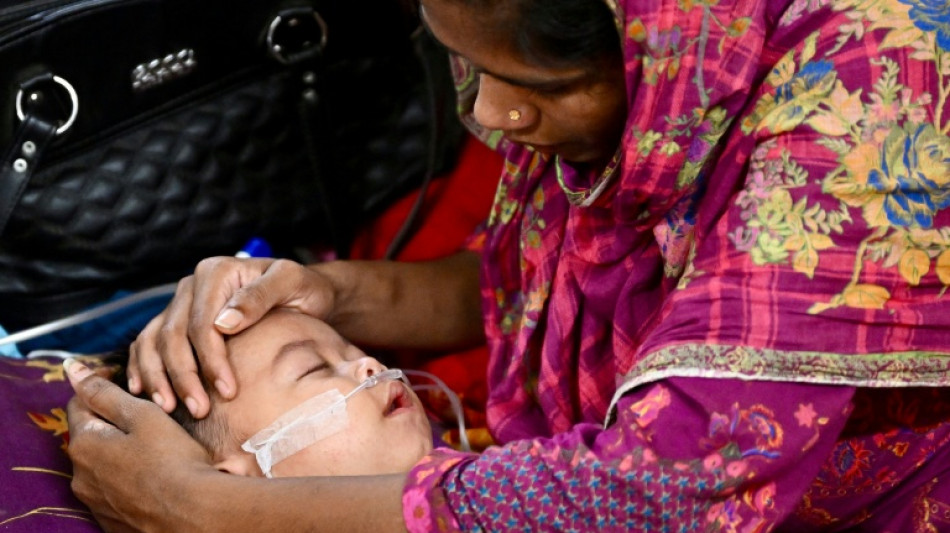
Rocking her baby to soothe his searing pain and gasping breaths, 18-year-old Rubia Akhtar Brishti recounts how her son nearly died in Bangladesh's deadly measles outbreak.
"The boy had high fever and found it hard to breath," Brishti told AFP, mopping the fevered brow of one-year-old Minhaz, cradled in her arms. "His whole body had rashes."
At least 143 people have died in the outbreak since March 15, the vast majority children, with more than 12,000 suspected cases -- the worst in the South Asian nation for 20 years.
Brishti, like dozens of others, rushed from her village seeking help in the capital Dhaka, where the DNCC Hospital in Mohakhali, set up originally for Covid-19, is flooded with cases.
The ward is filled with the sounds of coughing and cries of pain, as mothers hold nebulisers over their children's mouths to help their little lungs gulp for air, their tiny bodies marked by a searing rash.
Measles is one of the world's most contagious diseases, according to the World Health Organization, and spreads via coughs or sneezes.
While it can affect people of any age, it is most common among children and can cause complications, including brain swelling and severe breathing problems.
"Both of my children are sick now," said Nusrat Jahan, who had lost her vaccination cards and therefore missed getting her infants a shot. "Both the babies are suffering."
Her children were in different wards in the hospital.
"One is admitted on first floor and another is on second floor," she said. "I am caught in between, as both the children cry for me."
- Vaccine drive -
Bangladesh has made significant advancements in vaccinations to tackle infectious diseases.
But a measles drive due in 2024 was delayed by the deadly uprising that toppled the autocratic government of Sheikh Hasina.
Many of the families with sick children in the ward say they come from areas where vaccine coverage was limited.
Yasmin Khatun, grandmother of one-year-old Safwan, said she had tried to get the baby protected.
"We took him to the centre but there were no vaccines available for measles," she said.
Health authorities are scrambling to stop the spread and roll out vaccination campaigns.
Health authorities launched an emergency measles-rubella campaign on April 5, alongside UN agencies, aiming to protect more than 1.2 million children.
Vaccines work the best when all are covered.
Government health services spokesperson Zahid Raihan said that among the affected children, 17 percent had received a single dose, while 11 percent had received two doses.
"In the absence of herd immunity, children can still get infected even after vaccination," Raihan said, saying 95 percent coverage of children was needed to ensure that.
"Last year, the coverage was only 59 percent," he said.
Golam Mothabbir, from Save the Children Bangladesh, said the hardest hit places included the crowded capital Dhaka, as well as the densely packed refugee camps of Cox's Bazar, home to more than a million people.
"We know that if not enough vaccines are administered or if the vaccine campaign isn't sustained, the outbreak will continue to spread, and paediatric wards will continue to fill," Mothabbir said.
F.Castillo--LGdM