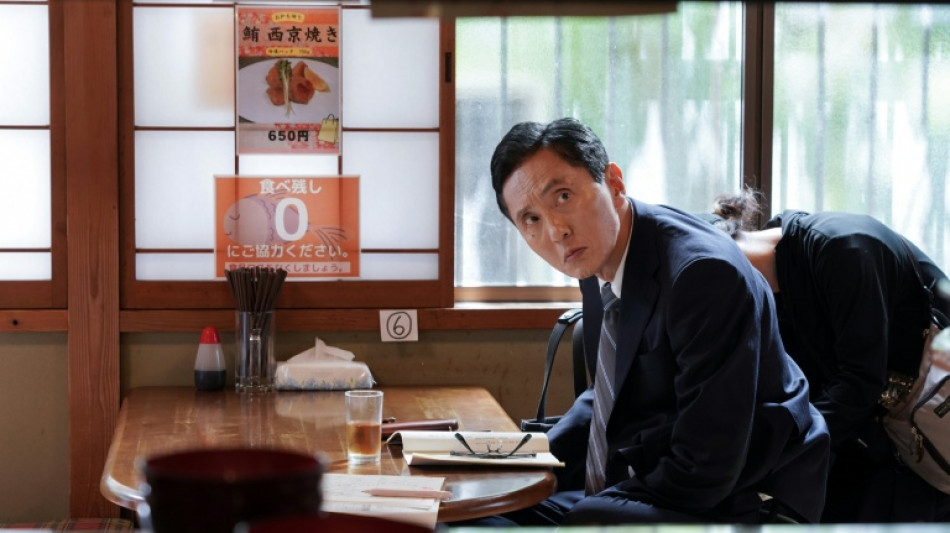
Table for one: how Japan's 'Solitary Gourmet' became a TV hit / Photo: © AFP

A lanky businessman ventures into a hole-in-the-wall restaurant and savours his meal alone.
It's a mundane premise for a TV show, yet Japan's "The Solitary Gourmet" draws a cult-like following around Asia, captivating millions of viewers with its simplicity, nostalgia and deeply quirky Japanese feel.
Combining culinary discovery with the showcase of local heritage, the show centres on fictional entrepreneur Goro Inogashira, who drives around in his Mini, using brief business meetings as a pretext for his gastronomic wanderings.
On a shoot for an episode of the latest season, which AFP visited, actor Yutaka Matsushige studies the menu at a tuna restaurant where the camera crew has set up, asks the owner for her recommendations, then suggests a rewrite of the script.
"The atmosphere of a restaurant, the welcome from the owners... all of that creates a story that Goro immerses himself in, and you immediately feel the life experience and history of the person behind the stove," Matsushige told AFP.
"When we talk with them, they sometimes suggest dishes that weren't planned, and we add them in during the shoot," he said.
The 63-year-old actor has been playing Inogashira, invariably dressed in a suit and tie, on screen since 2012.
The character is also the star of the eponymous manga by Jiro Taniguchi and Masayuki Kusumi on which the show is based.
- Nostalgia in a bowl of soup -
That original work "is less a story in the traditional sense than wanderings through unfamiliar regions where you simply stop to eat", Matsushige said.
"I wanted viewers to almost feel like they were watching a documentary," explained the actor, who over the course of his career has worked with a clutch of prominent Japanese filmmakers such as Takashi Miike, Kiyoshi Kurosawa and Takeshi Kitano.
During the show, Goro's internal musings about other diners at the restaurant as he nods approvingly at the food, peppered with close-ups of the dish, make for a distinctly Japanese experience.
Broadcast late at night in Japan, the series had at first very modest ratings before gradually finding its audience, including in Taiwan and South Korea, where some episodes were filmed. A Mandarin remake shot in Taiwan was also released.
Despite the success of the manga in Europe, the series is only available on YouTube.
Former South Korean president Yoon Suk Yeol, sentenced in February to life in prison for insurrection, declared in 2023 that he was a devoted fan.
For Matsushige, this success stems from the work's uniqueness.
"Nowadays, people expect TV series to be easy to follow and spectacular," he said.
"The expression of subtle nuances, like the nostalgia you feel while drinking a bowl of soup, is being lost."
With this show, "we wanted everyone to be able to have their own interpretation... I'd like the series to evoke abroad a sensibility closer to Yasujiro Ozu's films", which capture the subtle nuances of everyday life, than to the more grand and spectacular films of Akira Kurosawa.
A film adaptation, written and directed by Matsushige and partially shot in France, was released in Japan last year.
- Lifetime of experience -
The series also aims to support the family-run restaurants that host the shoots, which are never too chic or trendy, so as not to clash with Goro's character, noted producer Shiori Kojima.
But often the eateries brought into the spotlight subsequently see long lines forming at their doors.
Kenji Kamagata, 71, who has run his tuna restaurant for nearly three decades, admits he had previously refused any television appearance for that reason, changing his mind only because he is a "huge fan" of Matsushige.
The actor says he takes his family to dine in the restaurants where he has filmed, but always before the episode airs.
"Many traditional restaurants are gradually being replaced by chains," but those featured in the series "are often run by elderly people who are keeping their know-how alive," said Matsushige.
"You understand that the katsudon (a bowl of rice topped with breaded pork cutlet) is the fruit of an entire lifetime of experience.
"That's what makes the dish so delicious."
P.Gomez--LGdM