Kenya police violence victims say compensation promise a 'smokescreen' / Photo: © AFP

Two years ago, Gen-Z protests marked a new era for Kenyan politics, but led to dozens of deaths, and devastated families are unimpressed with government promises of compensation.
Memorial protests are planned on Thursday to mark two years since the country's biggest show of dissent, when Kenyans stormed parliament to protest new taxes amid wider anger over corruption.
It was seen as a watershed moment, as young Kenyans joined together to demand accountability with little regard for traditional ethnic dividing lines.
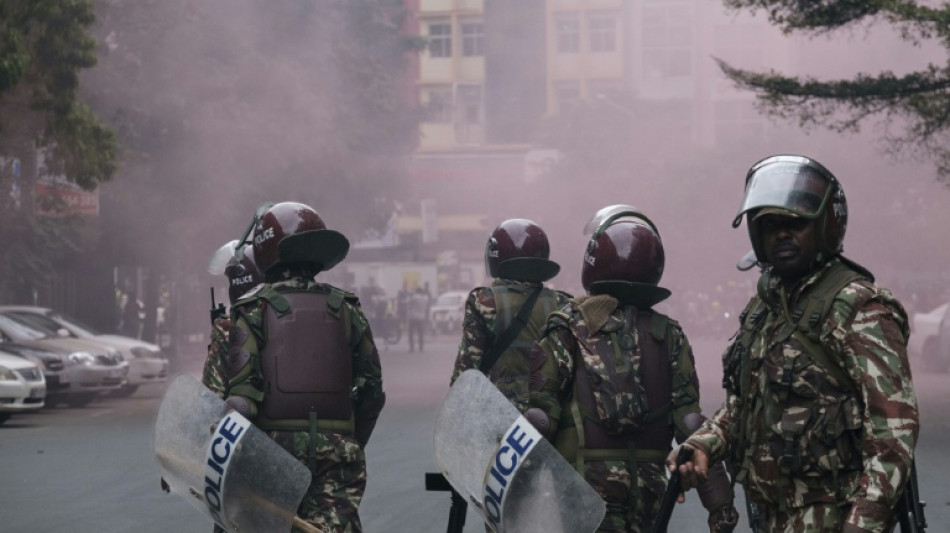
But it came at a price: some 62 people died during weeks of protests in June and July 2024, and another 65 died during anniversary protests in the same period the following year, according to the Independent Police Oversight Authority (IPOA).
Rights groups put the toll higher, and say the overwhelming majority were shot dead by police and security forces.
After showing little remorse for the killings, President William Ruto last week announced 2 billion shillings ($15.5 million) to compensate 1,100 people affected by violent protests between 2017 and 2025, and identified by rights groups.
He said it was an "acknowledgement that harm occurred" but stopped short of an apology.
"He's covering up the wrongs that he did. He just wants us to shut up because of the cash that he's giving us -- the peanuts," said Gillian Munyao, whose son, Rex Masai, 29, was among the first to die in the June 2024 protests.
"I'm not seeing justice anywhere... why pay us without giving the culprit?" Munyao told AFP at a Nairobi court last week, where the case is ongoing.
Only three cases from the 2024 protest deaths, and one from 2025, have come to court, according to the IPOA. No officer has been convicted.
Dozens of government critics were also abducted in 2024 and 2025, many never seen again, according to rights groups like Amnesty International and Human Rights Watch.
In May 2025, Ruto vowed to stop the abductions and said there was an "accountability mechanism" to bring those responsible to justice.
But many -- including his own former attorney general -- say he was directly responsible for the kidnappings, and there has been no sign of any investigation.
- 'Smoke-screen' -
Amnesty welcomed the compensation announcement as a "long-overdue opportunity to confront injustice".
But many victims do not know if they are on the list for compensation or whether any will actually arrive, said lawyer Nick Karanja, who represents several of them.
"It's a smokescreen as far as we are concerned," he told AFP.
One of his clients, Fenancia Njeri, 49, said she sometimes sees the policeman who killed her son, Issa Mburu, near an informal settlement outside Nairobi where she lives.
Her son was killed on July 7, 2025 -- the deadliest day of unrest last year -- after which Ruto said protesters who engaged in violence "should be shot in the leg".
"It's been a whole year... very, very hard," the still-grieving mother told AFP, adding that she has never been contacted by authorities about compensation and only learnt about the promise on television.
Kenyan police continue to kill people during bouts of unrest with apparent impunity, with the government usually dismissing victims as rioters.
At least four were killed during fuel protests in May, and three more during protests against a proposed Ebola quarantine centre for US citizens this month.
"Those are the things we are trying to change," said Rex Masai's father, Chrispine Odawa.
"Without justice, they will not bring any change. Protests are still coming," he told AFP.
A.Munoz--LGdM